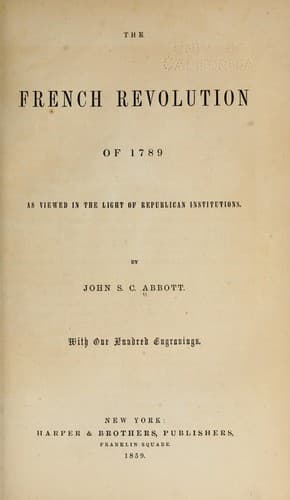
The French Revolution of 1789, as Viewed in the Light of Republican InstitutionsAbbott, John S. C. (John Stevens Cabot)
History
The French Revolution of 1789, as Viewed in the Light of Republican Institutions
Abbott, John S. C. (John Stevens Cabot)
France -- History -- Revolution, 1789-1799
An address was read to the Jacobin Club openly demanding the
annihilation of royalty; and though this address was received at first
with murmurs--for the majority, even of the Jacobins, were not then
prepared for such a step--the new doctrine with marvelous rapidity
spread through the lower orders of Paris, and very speedily gained the
ascendency in the club. Danton mounted the tribune of the Jacobin Club
on the 23d of June, and demanded the forfeiture of the throne. "Your
king," said he, "is either a knave or an idiot. If we must have one of
the two, who would not prefer the latter?"
The Jacobin Club had now become very formidable. It already numbered
eighteen hundred members in Paris alone, each of whom was admitted to
its meetings by a ticket. Two hundred and fifty affiliated clubs were
scattered throughout the principal cities. It occupied the large chapel
of the Convent, and had its president, its secretaries, its tribune,
its regular order of business, and its journal, in which its debates
and resolutions were published. Many of the ablest members of the
Assembly were members of the club, and their most powerful efforts of
eloquence were addressed to the club, regarding its voice as beginning
to be more potent than that of the Assembly. The Jacobin Club was
rapidly becoming the great power of the kingdom, with an excitable mob
ever at its disposal as its military arm.
The Journal of the Jacobins, edited by Laclos, a confidant of the Duke
of Orleans, overwhelmed the monarch with a torrent of insults and
objurgations. Thomas Paine, the notorious reviler of Christianity, was
then in Paris, and one of the most violent of the Jacobin Club. He
wrote an inflammatory address, which was posted on all the walls of
Paris, urging the peremptory dethronement of the king.
The views entertained by La Fayette and the Constitutional Monarchists
can not be better conveyed than in the eloquent language of Barnave, in
a speech addressed to the Assembly on this occasion.
"I will not dilate," said he, "on the advantages of monarchical
government. You have proved your conviction by establishing it in
your country. Some men, whose motives I shall not impugn, seeking
for examples to adduce, have found in America a people occupying a
vast territory with a scanty population, nowhere surrounded by very
powerful neighbors, having forests for their boundaries, and having
for customs the feelings of a new race, and who are wholly ignorant
of those factitious passions and impulses which effect revolutions of
government. They have seen a republican government established in that
land, and have thence drawn the conclusion that a similar government
was suitable for us.
Public-domain text, read in full here on John Shaqi.
Reviews
Reviews
No reviews yet
Be the first to share your thoughts on this work.
Elsewhere in the archive
Join the Discussion
Join the discussion
Sign in to leave a comment or review.
Sign InorCreate an account