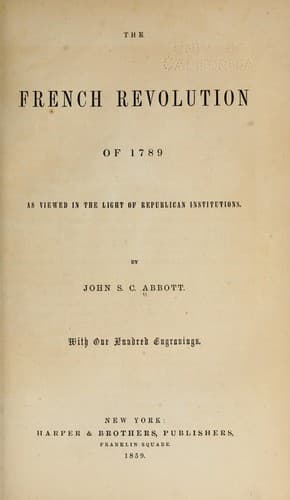
The French Revolution of 1789, as Viewed in the Light of Republican InstitutionsAbbott, John S. C. (John Stevens Cabot)
History
The French Revolution of 1789, as Viewed in the Light of Republican Institutions
Abbott, John S. C. (John Stevens Cabot)
France -- History -- Revolution, 1789-1799
"To Louis Stanislas Xavier, French Prince, the King's Brother,--I
wrote to you, my brother, on the 16th of October last, and you ought
not to have had any doubt of my real sentiments. I am surprised that
my letter has not produced the effect which I had a right to expect
from it. In order to recall you to your duty I have used all the
arguments that ought to touch you most. Your absence is a pretext for
all the evil disposed; a sort of excise for all the deluded French,
who imagine that they are serving me by keeping all France in an
alarm and agitation, which are the torment of my life.
"The Revolution is finished. The Constitution is completed. France
wills it; I will maintain it. Upon its consolidation now depends the
welfare of the monarchy. The Constitution has conferred rights upon
you; it has attached to them one condition which you ought to lose no
time in fulfilling. Believe me, brother, and repel the doubts which
pains are taken to excite in you respecting my liberty. I am going
to prove to you, by a most solemn act, and in a circumstance which
interests you, that I can act freely. Prove to me that you are my
brother and a Frenchman by complying with my entreaties. Your proper
place is by my side; your interests, your sentiments alike urge you
to come and resume it. I invite you, and, if I may, I order you to do
so. (Signed), Louis."
In a similar strain he wrote to his brother Charles. But neither the
proclamation to the emigrants nor the letters to his brothers produced
any effect. The Count of Provence (Louis XVIII.), in his reply, said,
"The order which the letter contains for me to return and resume my
place by your majesty's person is not the free expression of your will.
My honor, my duty, nay, even my affection alike forbid me to obey."
The Count of Artois (Charles X.) replied,
"The decisions referred to in this letter have furnished me with a
fresh proof of the moral and physical captivity in which our enemies
dare to hold your majesty. After this declaration your majesty will
think it natural that, faithful to my duty and the laws of honor, I
should not obey orders evidently wrung from you by violence."
Another very serious difficulty now arose. The Constitution established
freedom of conscience and of worship. It, however, justly required that
all governmental officers should take the oath of allegiance to the
Constitution. The Church had been so long in intimate alliance with the
State, that that alliance was not severed, and the clergy, as public
functionaries who received their salaries from the national treasury,
were consequently required to take the oath. Any one was at liberty to
refuse to take this oath. By so doing he merely forfeited employment
by the nation. He was still permitted to perform the functions of the
ministry for any who were disposed to support him as their pastor.
Public-domain text, read in full here on John Shaqi.
Reviews
Reviews
No reviews yet
Be the first to share your thoughts on this work.
Elsewhere in the archive
Join the Discussion
Join the discussion
Sign in to leave a comment or review.
Sign InorCreate an account