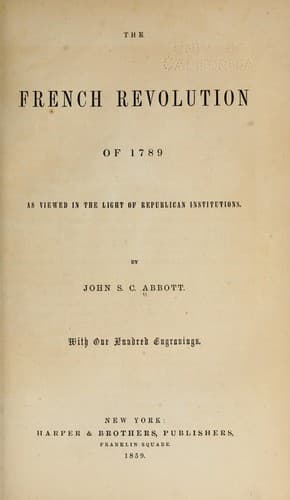
The French Revolution of 1789, as Viewed in the Light of Republican InstitutionsAbbott, John S. C. (John Stevens Cabot)
History
The French Revolution of 1789, as Viewed in the Light of Republican Institutions
Abbott, John S. C. (John Stevens Cabot)
France -- History -- Revolution, 1789-1799
There were between two and three millions of Protestants in France.[11]
The dragoons were sent in every direction through the kingdom,
enjoined by the court, to secure, at whatever expense of torture,
a return to Catholicism. One of the tortures which these merciless
fanatics were fond of applying was to deprive their victim of sleep.
They kept the sufferer standing, and relieved each other in their
cruel work of pinching, pricking, twitching, pulling with ropes,
burning, suffocating with offensive fumes, until after successive
days and nights of torture the victim was driven to madness, and to
promise any thing to escape from his tormentors. By these means, it was
boasted that in the district of Bordeaux, where there were one hundred
and fifty thousand Protestants, one hundred and forty thousand were
converted in a fortnight. The Duke of Noailles wrote to the court that
in the district to which he had been sent with his dragoons there had
been two hundred and forty thousand Protestants, but he thought that by
the end of the month none could be left.
In the year 1598 Henry IV., by the Edict of Nantes, had granted freedom
of conscience and of worship to the Protestants. Louis XIV. now issued
a decree revoking this edict. The revocation, which was signed the 18th
of October, 1685, states in the preamble that "since the better and the
greater part of our subjects of the pretended reformed religion have
embraced the Catholic faith, the maintenance of the Edict of Nantes
remains superfluous." It then declares that no more exercise of the
reformed worship is to be tolerated in the realm. All the Protestant
pastors were to leave the kingdom within fifteen days, and were
forbidden to exercise their office under pain of the galleys. Parents
were forbidden to instruct their children in the reformed faith, and
were enjoined to send them to the Catholic church to be baptized and to
be instructed in the Catholic schools and catechism, under penalty of a
fine of five hundred livres. The Protestant laity were prohibited from
emigrating under pain of the galleys for the men, and imprisonment for
life for the women.
Notwithstanding the penalty, vast numbers escaped from the kingdom.
No vigilance could guard such extended frontiers. In one year after
the revocation, Vauban wrote that France had lost one hundred thousand
inhabitants, twelve thousand disciplined soldiers, six hundred
officers, and her most flourishing manufactures. The Duke of St. Simon
records that "a fourth part of the kingdom was perceptibly depopulated."
These crimes perpetrated against religion filled the land with
infidelity. There were even Catholics of noble name and note, as
Fénélon and Massillon, who energetically remonstrated. Montesquieu,
Voltaire, Rousseau, and Mirabeau, not distinguishing between
Christianity and the Papal Church, uttered cries of indignation which
thrilled upon the ear of Europe and undermined the foundations of
Christianity itself.
Public-domain text, read in full here on John Shaqi.
Reviews
Reviews
No reviews yet
Be the first to share your thoughts on this work.
Join the Discussion
Join the discussion
Sign in to leave a comment or review.
Sign InorCreate an account