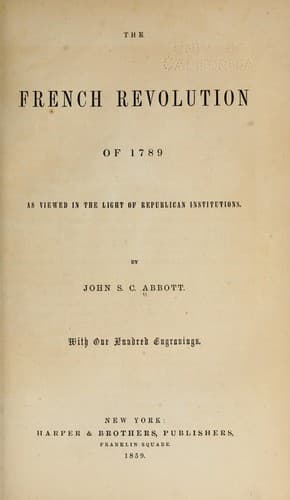
The French Revolution of 1789, as Viewed in the Light of Republican InstitutionsAbbott, John S. C. (John Stevens Cabot)
History
The French Revolution of 1789, as Viewed in the Light of Republican Institutions
Abbott, John S. C. (John Stevens Cabot)
France -- History -- Revolution, 1789-1799
In the year 1681 Louis XIV. commenced his system of dragooning the
Protestants into the Catholic faith. He sent regiments of cavalry into
the provinces, quartered them in the houses of the Protestants, placing
from four to ten in each family, and enjoined it upon these soldiers
to do every thing they could to compel the Protestants to return to
the Catholic faith. Scenes ensued too awful to be narrated. He who has
nerves to endure the recital can find the atrocities minutely detailed
in "_L'Histoire de l'Édit de Nantes, par Elias Benoît_."
The brutal soldiery, free from all restraint, committed every
conceivable excess. They scourged little children in the presence of
their parents, that the shrieks of agony of the child might induce
the parents to abjure their faith. They violated the modesty of women
and girls, and mangled their bodies with the lash. They tortured,
mutilated, disfigured. And when human nature in its extreme of agony
yielded, the exhausted victim was compelled to sign a recantation of
his faith, declaring that he did it of his own free will, without
compulsion or persuasion. In their terror the Protestants fled in all
directions, into the fields, the forests, to caves, and made desperate
endeavors to escape from the kingdom. Multitudes died of exhaustion and
famine by the way-side and on the sea-shore. Large tracts of country
were thus nearly depopulated. Madame de Maintenon wrote to her brother,
sending him a present of a large sum of money:
"I beseech you employ usefully the money you are to have. The lands in
Poitou are sold for nothing. The distresses of the Protestants will
bring more into market. You can easily establish yourself splendidly in
Poitou."
The Protestant countries, England, Switzerland, Holland, and Denmark,
issued proclamations to these persecuted Christians offering them
an asylum. The court was alarmed, and interdicted their leaving the
kingdom under penalty of condemnation to the galleys, confiscation of
their property, and the annulling of all contracts they should have
made for a year before their emigration.[10]
The condition of the Protestants was now miserable in the extreme. It
was the determination of the court utterly to exterminate the reformed
faith. The Archbishop of Paris made out a list of the works of four
hundred authors who were considered as assailing Catholicism, and all
the libraries, public and private, of the kingdom were searched that
the condemned books might be burned.
Public-domain text, read in full here on John Shaqi.
Reviews
Reviews
No reviews yet
Be the first to share your thoughts on this work.
Join the Discussion
Join the discussion
Sign in to leave a comment or review.
Sign InorCreate an account