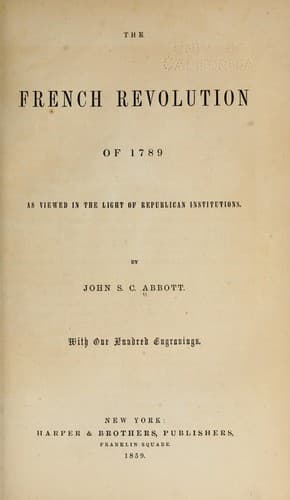
The French Revolution of 1789, as Viewed in the Light of Republican Institutions — John Shaqi
The French Revolution of 1789, as Viewed in the Light of Republican InstitutionsAbbott, John S. C. (John Stevens Cabot)
History
The French Revolution of 1789, as Viewed in the Light of Republican Institutions
Abbott, John S. C. (John Stevens Cabot)
France -- History -- Revolution, 1789-1799
The reign of Louis XIV. was that of an Oriental monarch. His authority
was unlimited and unquestioned. The people had two powerful foes,
the king and the nobles. The nobles, as the most numerous, were the
most dreaded. The people consequently looked to the kings to protect
them against the nobles, as sheep will look to their natural enemy,
the dogs, to defend them from their still worse enemies, the wolves.
The king had now obtained a perfect triumph over the nobles, and
had gathered all the political power into his own hands. He had
accomplished this by bribery, as well as by force. The acquiescence of
the nobles in his supremacy was purchased by his conferring upon them
all the offices of honor and emolument, by exempting them from all
taxes, and by supporting them in indolence, luxury, and vice, from the
toil of the crushed and starving masses. There were now in the nation
two classes, and two only, with an impassable gulf between them. On the
one side were eighty thousand aristocratic families living in idleness
and luxury; on the other were twenty-four millions of people, who, as
a mass, were kept in the lowest poverty, maintaining by their toil the
haughty nobles, from whom they received only outrage and contempt.
Louis XIV. just before his death drew up an edict appointing a council
of regency during the minority of his great-grandson, the young king.
The Parliament of Paris, however, declared the will null, and appointed
the Duke of Orleans, who was considered favorable to the nobles,
regent! For eight years, from 1715 to 1723, the regent, by shameless
profligacy and extravagance, was but filling up the measure of wrath
which had been accumulating for ages. Nothing was done to promote
the welfare of the people, and, notwithstanding the misery which was
actually depopulating the provinces, the gorgeous palaces of France
exhibited scenes of voluptuousness which the wealth of the Orient had
never paralleled.
Louis XIV. had expended upon the single palace of Versailles more than
two hundred millions of dollars. The roofs of that vast pile would
cover a surface of twenty-five French acres. Thirty thousand laborers
were frequently employed simultaneously in embellishing the magnificent
park sixty miles in circuit.[16] Marly, with its fountains, its parks,
and gardens, had also been constructed with equal extravagance. Both of
these palaces exhibited scenes of measureless profligacy gilded by the
highest fascinations of external refinement and elegance. Louis XIV.
left the nation in debt eight hundred and fifty millions of dollars.
For several years the expenditure had exceeded the income by nearly
thirty millions of dollars a year. The regent during the seven years
of his profligate administration had added to this debt a hundred and
fifty millions of dollars.
Public-domain text, read in full here on John Shaqi.
Reviews
Reviews
No reviews yet
Be the first to share your thoughts on this work.
Join the Discussion
Join the discussion
Sign in to leave a comment or review.
Sign InorCreate an account