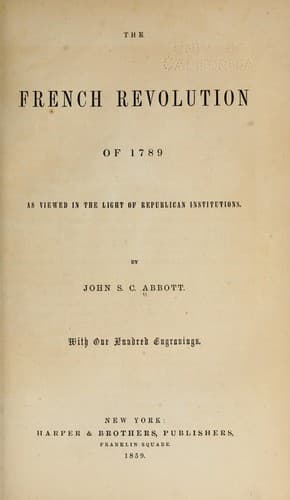
The French Revolution of 1789, as Viewed in the Light of Republican InstitutionsAbbott, John S. C. (John Stevens Cabot)
History
The French Revolution of 1789, as Viewed in the Light of Republican Institutions
Abbott, John S. C. (John Stevens Cabot)
France -- History -- Revolution, 1789-1799
There was now fearful embarrassment in the finances. All the measures
for extorting money seemed to be exhausted, and it was found impossible
to raise the sums necessary to meet the expenses of the court and
to pay the interest upon the debt. Taxation had gone to its last
extremity; and no more money could be borrowed. The Duke of St. Simon
proposed that the treasury should declare itself bankrupt.
"The loss," said he, "will fall upon the commercial and moneyed
classes, whom no one fears or pities. The measure," he continued, "will
also be a salutary rebuke to the ignoble classes, teaching them to
beware how they lend money to the king which will enable him to gain
the supremacy over the nobles."
The Duke of Orleans, who was regent only, not king, could sympathize in
these views. The general discontent, however, was such, that he did not
dare to resort to so violent a measure. The end was accomplished in a
more circuitous way. A commission of courtiers was appointed to examine
the accounts of the public creditors. Three hundred and fifty millions
of francs ($76,000,000) were peremptorily struck from their claims.
There was no appeal. This mode of paying debts seemed so successful
that the commission established itself as an inquisitorial chamber, and
summoned before it all those who had been guilty of lending money to
the king. Most of these were thrown into prison, and threatened with
death unless they purchased pardon for the crime with large sums of
money. The regent and the nobles made themselves merry with the woes of
these low-born men of wealth, and filled their purses by selling their
protection.
A wealthy financier was perishing in one of the dungeons of the
Bastille. A count visited him and offered to procure his release for
sixty thousand dollars. "I thank you, Monsieur le Comte," was the
reply, "but Madame, your countess, has just been here, and has promised
me my liberty for half that sum."
The reign of the regent Duke of Orleans was the reign of the nobles,
and they fell eagerly upon the people, whom Louis XIV. had sheltered
from their avarice that more plunder might be left for him. The
currency was called in and recoined, one fifth being cut from the
value of each piece. By this expedient the court gained nearly fifteen
millions of dollars.
Public-domain text, read in full here on John Shaqi.
Reviews
Reviews
No reviews yet
Be the first to share your thoughts on this work.
Join the Discussion
Join the discussion
Sign in to leave a comment or review.
Sign InorCreate an account