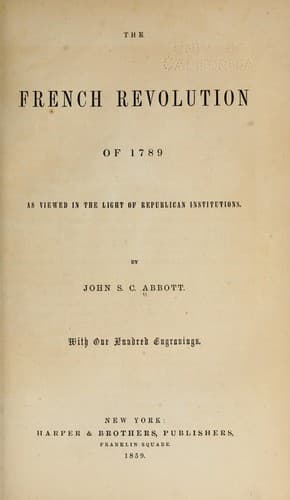
The French Revolution of 1789, as Viewed in the Light of Republican InstitutionsAbbott, John S. C. (John Stevens Cabot)
History
The French Revolution of 1789, as Viewed in the Light of Republican Institutions
Abbott, John S. C. (John Stevens Cabot)
France -- History -- Revolution, 1789-1799
Fanaticism so cruel was revolting to the intelligence and to the
general conscience of the age. Maddened priests could easily goad on
a brutal and exasperated populace to any deeds of inhumanity, but
intelligent men of all parties condemned such intolerance. It is,
however, worthy of note that few of the _philosophers_ of that day
ventured to plead for religious toleration. They generally hated
Christianity in all its forms, and were not at all disposed to shield
one sect from the persecutions of another. Voltaire, however, was an
exception. He had spent a year and a half in the Bastille on the charge
of having written a libel against the government, which libel he did
not write. When it was proved to the court that he did not write the
libel he was liberated from prison and banished from France. Several
years after this, Voltaire, having returned to France, offended a
nobleman, the Chevalier de Rohan. The chevalier disdainfully sent his
servant to chastise the poet. Voltaire, enraged by the degradation,
sent a challenge to De Rohan. For the crime of challenging a noble he
was again thrown into the Bastille. After six months he was released
and again exiled. Soon after his _Lettres Philosophiques_ were
condemned by the Parliament to be burned, and an order was issued for
his arrest. For many years he was compelled to live in concealment. He
thus learned how to sympathize with the persecuted. In his masterly
treatise upon toleration, and in his noble appeals for the family of
the murdered Protestant, Jean Calas, he spoke in clarion tones which
thrilled upon the ear of France. When Franklin in Paris called upon
Voltaire, with his grandson, he said, "My son, fall upon your knees
before this great man." The aged poet, then over eighty years of age,
gave the boy his blessing, with the characteristic words, "_God and
freedom_." The philosophy of Voltaire overturned the most despicable of
despotisms. His want of religion established another despotism equally
intolerable.
The miserable regent died in a fit in the apartment of his mistress in
1723. The young king was now fourteen years of age. He was a bashful
boy, with no thought but for his own indulgence. When a child he was
one day looking from the windows of the Tuileries into the garden,
which was filled with a crowd.
"Look there, my king," said Villeroi, his tutor; "all these people
belong to you. All that you see is your property; you are lord and
master of it."
Public-domain text, read in full here on John Shaqi.
Reviews
Reviews
No reviews yet
Be the first to share your thoughts on this work.
Join the Discussion
Join the discussion
Sign in to leave a comment or review.
Sign InorCreate an account