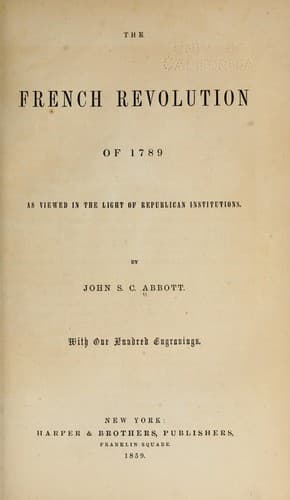
The French Revolution of 1789, as Viewed in the Light of Republican InstitutionsAbbott, John S. C. (John Stevens Cabot)
History
The French Revolution of 1789, as Viewed in the Light of Republican Institutions
Abbott, John S. C. (John Stevens Cabot)
France -- History -- Revolution, 1789-1799
Louis XV. carried these principles into vigorous practice during his
long reign of fifty-nine years. When fifteen years of age he married
Maria, daughter of Stanislaus, the exiled King of Poland. Maria was
not beautiful, but through a life of neglect and anguish she developed
a character of remarkable loveliness and of true piety. There is but
little to record of France during these inglorious years which is
worthy of the name of history. The pen can only narrate a shameful tale
of puerility, sin, and oppression. Weary and languid with worn-out
excitements, the king at one time took a sudden freak for worsted-work,
and the whole court was thrown into commotion as imitative nobles
and ecclesiastics were busy in the saloons of Versailles with wool,
needles, and canvas.
The king at one of his private suppers noticed a lady, Madame de
Mailly, whose vivacity attracted him. Simply to torture the queen he
took her for his favorite, and received her into the apartment from
which he excluded his meek and virtuous wife. Maria could only weep
and look to God for solace. Madame de Mailly had a sister, a bold,
spirited girl, Mademoiselle de Nesle. She came to visit the court, and
after vigorous efforts succeeded in supplanting her sister, and took
her degrading place. She was suddenly cut off in her sins by death;
but there was another sister of the same notorious family, Madame
Tournelle, who endeavored to solace the king by throwing herself into
his arms. The king received her, and she became his acknowledged
favorite, and for some time maintained the position of sultana of the
royal harem. Wherever she went a suite of court-ladies followed in her
train. All were compelled to pay homage to the reigning favorite of
the day, for all power was in her hands, and she was the dispenser of
rewards and punishments. The king conferred upon this guilty woman, who
was as cruel as she was guilty, the title of Duchess of Chateauroux.
Madame de Tencin, one of the ladies of the court, in a confidential
letter to Richelieu, written at this time, says:
"What happens in his kingdom seems to be no business of the king's.
It is even said that he avoids taking any cognizance of what occurs,
averring that it is better to know nothing than to learn unpleasant
tidings. Unless God visibly interferes, it is physically impossible
that the state should not fall to pieces."
Even Madame Chateauroux, herself one of the most corrupt members of
that court of unparalleled corruption, remarked to a friend,
"I could not have believed all that I now see. If no remedy is
administered to this state of things, there will, sooner or later, be a
great overthrow."[19]
Public-domain text, read in full here on John Shaqi.
Reviews
Reviews
No reviews yet
Be the first to share your thoughts on this work.
Join the Discussion
Join the discussion
Sign in to leave a comment or review.
Sign InorCreate an account