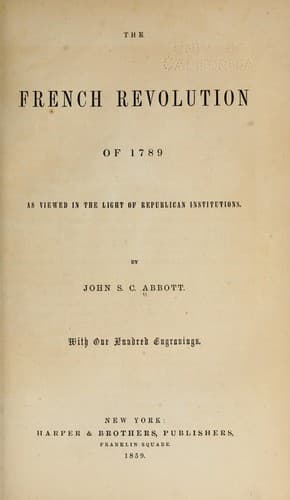
The French Revolution of 1789, as Viewed in the Light of Republican InstitutionsAbbott, John S. C. (John Stevens Cabot)
History
The French Revolution of 1789, as Viewed in the Light of Republican Institutions
Abbott, John S. C. (John Stevens Cabot)
France -- History -- Revolution, 1789-1799
"Very different indeed," beautifully writes Julia Kavanagh, "were the
declining years of Maria Lecsinska and those of the Marchioness of
Pompadour. The patient and pious queen laid her sufferings at the foot
of the cross. Insulted by her husband and his mistresses, neglected by
the courtiers, deeply afflicted by the loss of her children, whom she
loved most tenderly, she still found in religion the courage necessary
to support her grief, and effectual consolation in the practice of a
boundless benevolence."[20]
The old king was now utterly whelmed in the vortex of dissipation;
character, and even self-respect, seemed entirely lost. He looked
around for another female to take the place of Jeannette Poisson. In
one of the low haunts of Parisian debauchery, the courtiers of the king
found a girl of extraordinary beauty, calling herself Mademoiselle
Lange. She had been sewing in the shop of a milliner, but was now
abandoned to vice. She was introduced as a novelty to the voluptuous
monarch, and succeeded in fascinating him. She received the title of
Countess du Barry, and was immediately installed at Versailles as
the acknowledged favorite of the king. Vice never rises, but always
descends in the scale of degradation. The king had first selected
his favorites from the daughters of nobles, he then received one
from the class whom he affected to despise as low-born; and now a
common prostitute, taken from the warehouses of infamy in Paris,
uneducated, and with the manners of a courtesan, is presented to the
nation as the confidant and the manager of the despicable sovereign.
All the high-born ladies, accustomed as they were to the corruptions
of the court, regarded this as an insult too grievous to be borne.
The nobles, the clergy, the philosophers, and the people, all joined
in this outcry. But Madame du Barry, wielding the authority of the
king, was too strong for them all. She dismissed and banished from the
court the Duke of Choiseul, the king's minister, and to his post she
raised one of her own friends. She then, with astounding boldness,
suppressed the Parliaments, thus leaving to France not even the shadow
of representative power. Thus she proceeded, step by step, removing
enemies and supplanting them by friends, until the most noble of the
land were emulous of the honor of admission to the saloon of this
worthless woman.
It is an appalling and a revolting fact that for half a century before
the revolution _France was governed by prostitutes_. The real sovereign
was the shameless woman who, for the time being, kept control of the
degraded and sensual king. "The individual," says De Tocqueville, "who
would attempt to judge of the government by the men at the head of
affairs and not by the women who swayed those men, would fall into the
same error as he who judges of a machine by its outward action and not
by its inward springs."
Public-domain text, read in full here on John Shaqi.
Reviews
Reviews
No reviews yet
Be the first to share your thoughts on this work.
Join the Discussion
Join the discussion
Sign in to leave a comment or review.
Sign InorCreate an account