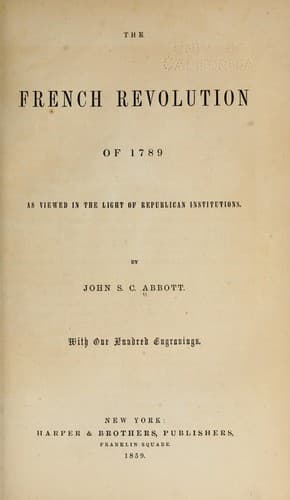
The French Revolution of 1789, as Viewed in the Light of Republican Institutions — John Shaqi
The French Revolution of 1789, as Viewed in the Light of Republican InstitutionsAbbott, John S. C. (John Stevens Cabot)
History
The French Revolution of 1789, as Viewed in the Light of Republican Institutions
Abbott, John S. C. (John Stevens Cabot)
France -- History -- Revolution, 1789-1799
The king was now so execrated that he dared not pass through Paris in
going from his palace at Versailles to Compiègne. Fearing insult and a
revolt of the people if he were seen in the metropolis, he had a road
constructed which would enable him to avoid Paris. As beautiful female
children were often seized to replenish his seraglio at the _Parc aux
Cerfs_, the people received the impression that he indulged in baths
of children's blood, that he might rejuvenate his exhausted frame. The
king had become an object of horror.[21]
Such was the state of affairs when the guilty king was attacked by the
small-pox, and died at Versailles in 1774, in the sixty-fourth year
of his age and the fifty-ninth of his reign. Such in brief was the
career of Louis XV. His reign was the consummation of all iniquity, and
rendered the Revolution inevitable. The story of his life, revolting
as it is, must be told; for it is essential to the understanding of
the results which ensued. The whirlwind which was reaped was but
the legitimate harvest of the wind which was sown. Truly does De
Tocqueville say, "The Revolution will ever remain in darkness to those
who do not look beyond it. It can only be comprehended by the light
of the ages which preceded it. Without a clear view of society in the
olden time, of its laws, its faults, its prejudices, its sufferings,
its greatness, it is impossible to understand the conduct of the French
during the sixty years which have followed its fall."
FOOTNOTES:
[Footnote 16: Galignani's Paris Guide.]
[Footnote 17: History of French Revolution, by E.E. Crowe, vol. ii., p.
150.--_Enc. Am._]
[Footnote 18: The Duke of St. Simon, who was one of the council of
the regency, in his admirable memoirs, gives the following sketch of
Dubois: "Dubois was a little, thin, meagre man, with a polecat visage.
All the vices, falsehood, avarice, licentiousness, ambition, and the
meanest flattery contended in him for the mastery. He lied to such a
degree as to deny his own actions when taken in the fact. In spite of
his debauchery he was very industrious. His wealth was immense, and his
revenue amounted to millions."]
[Footnote 19: Women of France, p. 91.]
[Footnote 20: Women of France, p. 170.]
[Footnote 21: Historical View of the French Revolution, by J. Michelet,
vol. i., p. 46.]
CHAPTER IV.
DESPOTISM AND ITS FRUITS.
Assumptions of the Aristocracy.--Molière.--Decay of the
Nobility.--Decline of the Feudal System.--Difference between France
and the United States.--Mortification of Men of Letters.--Voltaire,
Montesquieu, Rousseau.--Corruption of the Church.--Diderot.--The
Encyclopedists.--Testimony of De Tocqueville.--Frederic II. of
Prussia.--Two Classes of Opponents of Christianity.--Enormity of
Taxation.--Misery of the People.--"Good old Times of the Monarchy!"
Public-domain text, read in full here on John Shaqi.
Reviews
Reviews
No reviews yet
Be the first to share your thoughts on this work.
Join the Discussion
Join the discussion
Sign in to leave a comment or review.
Sign InorCreate an account