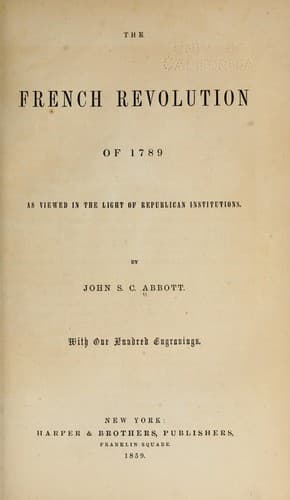
The French Revolution of 1789, as Viewed in the Light of Republican InstitutionsAbbott, John S. C. (John Stevens Cabot)
History
The French Revolution of 1789, as Viewed in the Light of Republican Institutions
Abbott, John S. C. (John Stevens Cabot)
France -- History -- Revolution, 1789-1799
In days of feudal grandeur the noble was indeed the lord and master of
the peasantry. He was their government and their sole protector from
violence. There was then reason for feudal service. But now the noble
was a drone. He received, and yet gave nothing, absolutely nothing,
in return. The peasant despised as well as hated him, and derisively
called him the _vulture_.
The feudal system is adapted only to a state of semi-barbarism. It can
no more survive popular intelligence than darkness can exist after the
rising of the sun. When, in the progress of society, nobles cease to be
useful and become only drones; when rich men, vulgar in character, can
purchase titles of nobility, so that the nobles cease to be regarded
as a peculiar and heaven-appointed race; when men from the masses,
unennobled, acquire opulence, education, and that polish of manners
which place them on an equality with titled men; when men of genius
and letters, introduced into the saloons of the nobles, discover their
own vast superiority to their ignorant, frivolous, and yet haughty
entertainers; and when institutions of literature, science, and art
create an aristocracy of scholarship where opulence, refinement, and
the highest mental culture combine their charms, then an hereditary
aristocracy, which has no support but its hereditary renown, must die.
Its hour is tolled.
Such was the state of France at the close of the reign of Louis XV.
It is estimated that there were in France at that time five hundred
thousand well-informed citizens.[25] This fact explains both the
outbreak of the Revolution and its failure. They were too many to
submit to the arrogance of the nobles; hence the insurrection. They
were too few to guide and control the infuriated masses when the
pressure was taken from them, and hence the reign of terror, the
anarchy and blood. The United States, with a population about the same
as that of France in the morning of her Revolution, has four or five
millions of intelligent and well-educated men. These men support our
institutions. But for them, the republic would be swept away like chaff
before the wind.
As we have before said, men of letters were patronized by the king and
the court, but it was a patronage which seemed almost an insult to
every honorable mind. The haughty duke would look down condescendingly,
and even admiringly, upon the distinguished scholar, and would admit
him into his saloon as a curiosity. High-born ladies would smile
upon him, and would condescend to take his arm and listen to his
remarks. But such mingling with society stung the soul with a sense
of degradation, and none inveighed with greater bitterness against
aristocratic assumption than those men of genius who had been most
freely admitted into the halls of the great. They were thus exasperated
to inquire into the origin of ranks, and their works were filled with
eulogiums of equality and fraternity.
Public-domain text, read in full here on John Shaqi.
Reviews
Reviews
No reviews yet
Be the first to share your thoughts on this work.
Join the Discussion
Join the discussion
Sign in to leave a comment or review.
Sign InorCreate an account