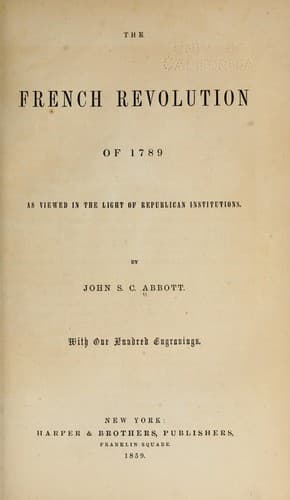
The French Revolution of 1789, as Viewed in the Light of Republican InstitutionsAbbott, John S. C. (John Stevens Cabot)
History
The French Revolution of 1789, as Viewed in the Light of Republican Institutions
Abbott, John S. C. (John Stevens Cabot)
France -- History -- Revolution, 1789-1799
It was this social degradation which was one of the strongest
incentives to revolution. This united all the industrial classes in
France, all who had attained wealth, and all men of intellectual
eminence, in the cry for reform. Equality of rights was the great
demand thus forced from the heart of the nation. _Fraternity_ became
the watch-word of the roused and rising masses.[26]
Thought was the great emancipator. Men of genius were the Titans who
uphove the mountains of prejudice and oppression. They simplified
political economy, and made it intelligible to the popular mind.
Voltaire assailed with keenest sarcasm and the most piercing invectives
the corruptions of the Church, unjustly, and most calamitously for the
interests of France, representing those corruptions as Christianity
itself. Montesquieu popularized and spread before the nation those
views of national policy which might render a people prosperous and
happy; and Rousseau, with a seductive eloquence which the world has
never seen surpassed, excited every glowing imagination with dreams of
fascinating but unattainable perfection. Nearly all the revolutionary
writers represented religion not merely as a useless superstition, but
as one of the worst scourges of the state. Thus they took from the
human heart the influence which alone can restrain passion and humanize
the soul.
They represented man but as a lamb, meek and innocent, dumb before
his shearers, and seeking only to live harmlessly and happily in the
outflowings of universal benevolence and love. This lamb-like man
needed no more religion than does the butterfly or the robin. He was to
live his joyous day, unrestrained by customs, or laws, or thoughts of
the future, and then was to pass away like the lily or the rose, having
fulfilled his function. Death an eternal sleep, was the corner-stone
of their shallow and degrading philosophy. The advocates of this
sentimentalism were amazed when they found the masses, brutalized by
ignorance and ages of oppression, and having been taught that there was
no God before whom they were to stand in judgment, come forth into the
arena of the nations, not as lambs, but as wolves, thirsting for blood
and reckless in devastation. Libertines in France are still infidels,
but they have seen the effect of their doctrines, and no longer dare
to proclaim them. "Where is the Frenchman of the present day," says
De Tocqueville, "who would write such books as those of Diderot or
Helvetius?"[27]
Public-domain text, read in full here on John Shaqi.
Reviews
Reviews
No reviews yet
Be the first to share your thoughts on this work.
Join the Discussion
Join the discussion
Sign in to leave a comment or review.
Sign InorCreate an account