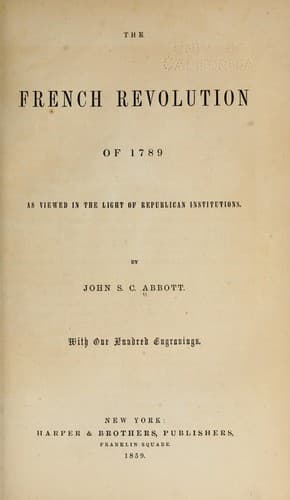
The French Revolution of 1789, as Viewed in the Light of Republican InstitutionsAbbott, John S. C. (John Stevens Cabot)
History
The French Revolution of 1789, as Viewed in the Light of Republican Institutions
Abbott, John S. C. (John Stevens Cabot)
France -- History -- Revolution, 1789-1799
So excessive was the burden of taxation, that it has been estimated
by a very accurate computation that, if the produce of an acre of
land amounted to sixteen dollars, the king took ten, the duke, as
proprietor, five, leaving one for the cultivator.[32] Thus, if we
suppose a peasant with his wife and children to have cultivated forty
acres of land, the proceeds of which, at sixteen dollars per acre,
amounted to six hundred and forty dollars, the king and the duke and
the Church took six hundred of this, leaving but forty dollars for the
support of the laborers.
Let us suppose a township in the United States containing twenty square
miles, with five thousand inhabitants. Nearly all these are cultivators
of the soil, and so robbed by taxes that they can only live in mud
hovels and upon the coarsest food. Clothed in rags, they toil in the
fields with their bareheaded and barefooted wives and daughters.
The huts of these farmers are huddled together in a miserable dirty
village. In the village there are a few shop-keepers, who have acquired
a little property, and have become somewhat intelligent. There is
also a physician, and a surgeon, and a poor, dispirited, half-starved
parish priest. Upon one of the eminences of the town there is a lordly
castle of stone, with its turrets and towers, its park and fish-pond.
This massive structure belongs to the duke. Weary of the solitude of
the country, he has withdrawn from the castle, and is living with his
family in the metropolis, indulging in all its expensive dissipations.
His purse can only be replenished by the money which he can extort from
the cultivators of the land who surround his castle; and his expenses
are so enormous that he is ever harassed by an exhausted purse.
For a few weeks in the summer he comes down to his castle, from the
metropolis, with his city companions, to engage in rural sports. Wild
boars, deer, rabbits, and partridges abound in his park. The boars and
the deer range the fields of the farmers, trampling down and devouring
their crops; but the farmer must not harm them, lest he incur the
terrible displeasure of the duke. The rabbits and the partridges infest
the fields of grain; but the duke has issued a special injunction that
the weeds _even_ must not be disturbed, lest the brooding partridges
should be frightened away, to the injury of his summer shooting.
Public-domain text, read in full here on John Shaqi.
Reviews
Reviews
No reviews yet
Be the first to share your thoughts on this work.
Join the Discussion
Join the discussion
Sign in to leave a comment or review.
Sign InorCreate an account