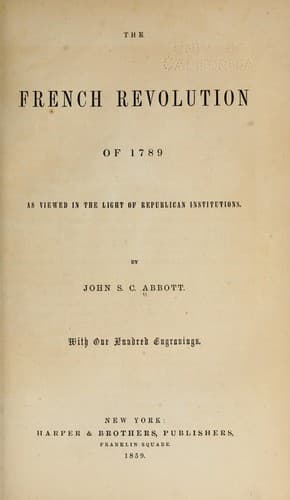
The French Revolution of 1789, as Viewed in the Light of Republican InstitutionsAbbott, John S. C. (John Stevens Cabot)
History
The French Revolution of 1789, as Viewed in the Light of Republican Institutions
Abbott, John S. C. (John Stevens Cabot)
France -- History -- Revolution, 1789-1799
The imposition of the tax was entirely arbitrary. No man could tell
one year what his tax would be the next. There was no principle in the
assessment except to extort as much as possible. The tax-gatherers
would be sent into a district to collect one year one million of
francs, perhaps the next year it would be two millions. No language
can describe the dismay in the humble homes of the peasants when these
cormorants, armed with despotic power, darkened their doors. The
seed-corn was taken, the cow was driven off, the pig was taken from
the pen. Mothers plead with tears that food might be left for their
children, but the sheriff, inured to scenes of misery, had a heart of
rock. He always went surrounded by a band of bailiffs to protect him
from violence. Fearful was the vengeance he could wreak upon any one
who displeased him.
The peasant, to avoid exorbitant taxation, assumed the garb of poverty,
dressed his children in rags, and carefully promoted the ruin and
dilapidation of his dwelling. "Fear," writes de Tocqueville, "often
made the collector pitiless. In some parishes he did not show his face
without a band of bailiffs and followers at his back. 'Unless he is
sustained by bailiffs,' writes an intendant in 1764, 'the taxables will
not pay. At Villefranche alone six hundred bailiffs and followers are
always kept on foot.'"[31]
Indeed, the government seemed to desire to keep the people poor.
Savages will lop off the leg or the arm of a prisoner that he may
be more helplessly in their power. Thus those despotic kings would
desolate their realms with taxation, and would excite wars which
would exhaust energy and paralyze industry, that the people thus
impoverished and kept in ignorance might bow more submissively to
the yoke. The wars which in endless monotony are inscribed upon the
monuments of history were mostly waged by princes to engross the
attention of their subjects. When a despot sees that public attention
is directed, or is likely to be directed, to any of his oppressive
acts, he immediately embarks in some war, to divert the thoughts of
the nation. This is the unvarying resource of despotism. After a few
hundred thousand of the people have been slaughtered, and millions of
money squandered in the senseless war, peace is then made. But peace
brings but little repose to the people. They must now toil and starve
that they may raise money to pay for the expenses of the war. Such, in
general, has been the history of Europe for a thousand years. Despots
are willing that billows of blood should surge over the land, that the
cries of the oppressed may thus be drowned.
Public-domain text, read in full here on John Shaqi.
Reviews
Reviews
No reviews yet
Be the first to share your thoughts on this work.
Join the Discussion
Join the discussion
Sign in to leave a comment or review.
Sign InorCreate an account