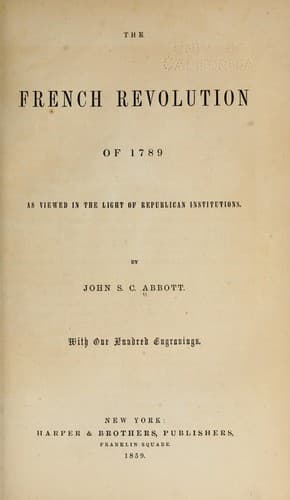
The French Revolution of 1789, as Viewed in the Light of Republican InstitutionsAbbott, John S. C. (John Stevens Cabot)
History
The French Revolution of 1789, as Viewed in the Light of Republican Institutions
Abbott, John S. C. (John Stevens Cabot)
France -- History -- Revolution, 1789-1799
[Footnote 24: "Men of rank sold their land piecemeal to the peasantry,
reserving nothing but seigneurial rents, which furnished a nominal but
not a substantial competency."--_The Old Régime, De Tocqueville_, p.
103.]
[Footnote 25: History of the French Revolution, by M. Rabaud de St.
Etienne, p. 188.]
[Footnote 26: "A lord," writes Montesquieu, bitterly, "is a man who
sees the king, speaks to the minister, has ancestors, debts, and
pensions."]
[Footnote 27: The Old Régime, by De Tocqueville, p. 18.
"It is a singularity worth remarking that the Gospel is nothing but a
declaration of rights. Its mysteries were a long time hidden, because
they attacked the priests and the great."--_M. Rabaud de St. Etienne_,
p. 174.]
[Footnote 28: "Shall we say, then, Woe to Philosophism that
it destroyed Religion, what it called 'extinguishing the
abomination'--_écraser l'infâme_? Woe rather to those that made the
Holy an abomination and extinguishable."--_Carlyle, French Revolution_,
i., 56.]
[Footnote 29: Old Régime, p. 175.
Count Segur, a peer of France, in his Memoirs, has very frankly
described the feelings with which he and the young nobles who were his
companions regarded the writings of the philosophers:
"We felt disposed to adopt with enthusiasm the philosophical doctrines
professed by literary men, remarkable for their boldness and their wit.
Voltaire seduced our imagination. Rousseau touched our hearts. We felt
a secret pleasure in seeing that their attacks were directed against an
old fabric which presented to us a Gothic and ridiculous appearance.
We were pleased with this petty war, although it was undermining our
own ranks and privileges and the remains of our ancient power. But we
felt not these attacks personally. It was, as yet, but a war of words
and paper, which did not appear to us to threaten the superiority
of existence which we enjoyed, consolidated as we thought it by a
possession of many centuries."]
[Footnote 30: History of the Revolution of France, by M. Rabaud de St.
Etienne.]
[Footnote 31: For appalling proof of the sufferings of the tax-payers,
turn to the pages of Michelet, of De Tocqueville, of any writer upon
the _Old Régime_.]
[Footnote 32: Arthur Young, vol. i., p. 574; Marshall's Travels, vol.
iv., p. 322.]
[Footnote 33: "Care must be taken not to misunderstand the gayety which
the French have often exhibited in the greatest affliction. It is a
mere attempt to divert the mind from the contemplation of misfortune
which seems inevitable."--_The Old Régime, by De Tocqueville_, p. 167.]
[Footnote 34: Life of Jefferson, by Henry T. Randall, vol. i., p. 432.]
CHAPTER V.
THE BASTILLE.
Absolute Power of the King.--_Lettres de Cachet._--The
Bastille.--Cardinal Balue.--Harancourt.--Charles of
Armanac.--Constant de Renville.--Duke of Nemours.--Dungeons
of the Bastille.--_Oubliettes._--Dessault.--M. Massat.--M.
Catalan.--Latude.--The Student.--Apostrophe of Michelet.
Public-domain text, read in full here on John Shaqi.
Reviews
Reviews
No reviews yet
Be the first to share your thoughts on this work.
Join the Discussion
Join the discussion
Sign in to leave a comment or review.
Sign InorCreate an account