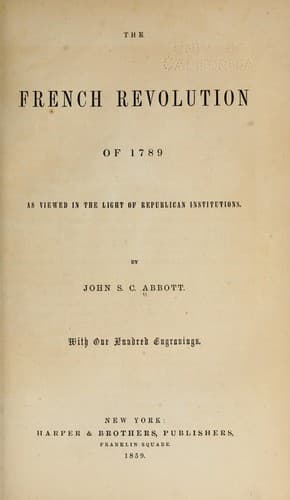
The French Revolution of 1789, as Viewed in the Light of Republican Institutions — John Shaqi
The French Revolution of 1789, as Viewed in the Light of Republican InstitutionsAbbott, John S. C. (John Stevens Cabot)
History
The French Revolution of 1789, as Viewed in the Light of Republican Institutions
Abbott, John S. C. (John Stevens Cabot)
France -- History -- Revolution, 1789-1799
The monarchy was now so absolute that the king, without any regard to
law, had the persons and the property of all his subjects entirely at
his disposal. He could confiscate any man's estate. He could assign any
man to a dungeon for life without trial and even without accusation. To
his petted and profligate favorites he was accustomed to give sealed
writs, _lettres de cachet_, whose blanks they could fill up with any
name they pleased. With one of these writs the courtiers could drag
any man who displeased them to one of the dungeons of the Bastille,
where no light of the sun would ever gladden his eyes again. Of these
sealed writs we shall speak hereafter. They were the most appalling
instruments of torture despotism ever wielded.
_The Bastille._ At the eastern entrance of Paris stood this
world-renowned fortress and prison. In gloomy grandeur its eight towers
darkened the air, surrounded by a massive wall of stone nine feet thick
and a hundred feet high. The whole was encircled by a ditch twenty-five
feet deep and one hundred and twenty feet wide. The Bastille was an
object exciting universal awe. No one could ever pass beneath its
shadow without thinking of the sighs which ceaselessly resounded
through all its vaults. It was an ever-present threat, the great
upholder of despotic power, with its menace appalling even the boldest
heart. It is easy to brave death from the bullet or the guillotine;
but who can brave the doom of Cardinal Balue, who, for eleven years,
was confined in an iron cage, so constructed that he could find no
possible position for repose; or the fate of Harancourt, who passed
fifteen years in a cage within the Bastille, whose iron bars required
in their riveting the labors of nineteen men for twenty days? To be
thus torn from wife, children, and home, and to be consigned for life
to the unearthly woe of such a doom must terrify even the firmest soul.
It is painful to dwell upon these details, but they must be known in
explanation of the scenes of violence and blood to which they finally
gave birth.
Charles of Armanac, for no crime whatever of his own, but because
his _brother_ had offended Charles XI., was thrown into prison. For
fourteen years he lingered in the dungeon, until his reason was
dethroned and his spirit was bewildered and lost in the woes of the
maniac. Constant de Renville, a Norman gentleman, was accused, while
in exile in Holland, of writing a satirical poem against France. For
eleven years he was immured in one of the most loathsome dungeons of
the Bastille. He appears to have been a man of true piety, and upon
his release wrote an account of the horrors of his prison-house, which
thrilled the ear of Europe.
Public-domain text, read in full here on John Shaqi.
Reviews
Reviews
No reviews yet
Be the first to share your thoughts on this work.
Join the Discussion
Join the discussion
Sign in to leave a comment or review.
Sign InorCreate an account