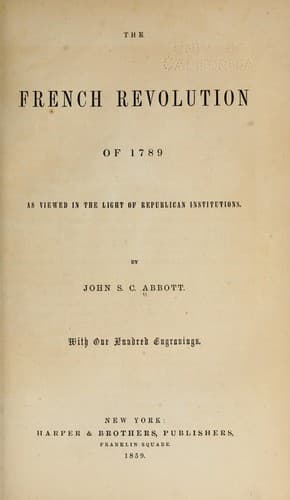
The French Revolution of 1789, as Viewed in the Light of Republican InstitutionsAbbott, John S. C. (John Stevens Cabot)
History
The French Revolution of 1789, as Viewed in the Light of Republican Institutions
Abbott, John S. C. (John Stevens Cabot)
France -- History -- Revolution, 1789-1799
The attempt to establish the new courts was a total failure. The
clergy, the nobility, and the people were all against it. A universal
storm of hatred and contempt fell upon all who accepted offices in
those courts. The Plenary Court held but one session, and then expired
amid the hisses of all classes. The king seemed suddenly bereft of
authority.
"Let a commissioner of the king," says Weber, "enter one of these
parliaments to have an edict registered, the whole tribunal will
disappear, leaving the commissioner alone with the clerk and president.
The edict registered and the commissioner gone, the whole tribunal
hastens back to declare such registration null. The highways are
covered with deputations of the parliaments, proceeding to Versailles
to have their registers expunged by the king's hand, or returning home
to cover a new page with new resolutions still more audacious."[75]
Still there was no money, and Brienne was in despair. Wistfully he
looked to his embowered chateau at Brienne, with its silent groves
and verdant lawn. There, while these scenes were transpiring, had
sat, almost beneath the shadow of his castle, "a dusky-complexioned,
taciturn boy, under the name of Napoleon Bonaparte." This boy,
forgetful of the sports of childhood, was gazing with intensest
interest upon the conflict, and by untiring study, night and day,
was girding himself with strength to come forth into the arena. He
had already taken his side as the inexorable foe of feudal privilege
and the friend of popular rights. He had already incurred the frown
of his teachers for the energy with which he advocated in his themes
the doctrine of equality. "The themes of Napoleon," said one of his
teachers, "are like flaming missiles ejected from a volcano."
In these fearful scenes, ominous of approaching floods and earthquakes,
God, in the awful mystery of his providence, took an energetic part.
On the 13th of July of this year, 1788, the whole country, for one
hundred and twenty miles around Paris, was laid waste by one of the
most frightful hail-storms which ever beat down a harvest. Not a green
blade was left. Gaunt famine was inevitably to stride over distracted,
impoverished France. Consternation oppressed all hearts. It was now
hastily decided that the States-General should be assembled in the
following month of May. The queen was that day standing at one of the
windows of Versailles, pallid, trembling, and lost in gloomy thought.
She held in her hand a cup of coffee, which, mechanically, she seemed
to sip. Beckoning to Madame Campan, she said to her,
"Great God! what a piece of news will be made public to-day. The king
grants States-General. 'Tis a first beat of the drum of ill omen for
France. This noblesse will ruin us."[76]
Public-domain text, read in full here on John Shaqi.
Reviews
Reviews
No reviews yet
Be the first to share your thoughts on this work.
Elsewhere in the archive
Join the Discussion
Join the discussion
Sign in to leave a comment or review.
Sign InorCreate an account