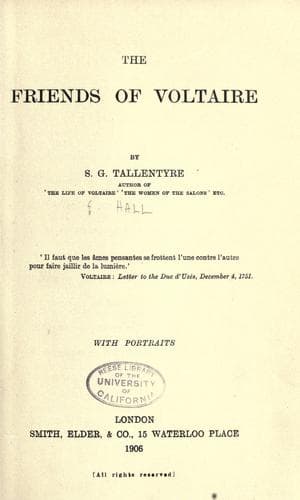
France -- Biography; Voltaire, 1694-1778 -- Friends and associates
Meanwhile, it had given Helvétius the best solace chagrins and declining
life can have--a regular occupation. He was not old, and he was framed,
says Guillois, to be a centenarian. But at that epoch men spent their
health and strength with such fearful prodigality in their youth, that
they rarely lived beyond what is now called middle age. Helvétius was
not more than five-and-fifty when he became conscious of failing powers.
Sport, which had been the delight of his life, lost its zest. The
bankrupt condition of his country, her light-hearted descent to ruin,
lay heavily now on a soul framed by nature to take the world serenely
and to see the future fair. He was occupied, it is true, to the end in
those works of benevolence and kindness which pay an almost certain
interest in happiness to him who invests in them. Then, too, to the
last, there was his wife, who might have loved a better man than he,
but who--love, fortunately for most people, not being given entirely to
worth--spent on him the fidelity and devotion of her life.
On December 26, 1771, Helvétius died. He was buried in the Church of
Saint-Roch, in Paris.
Minette, a very rich widow, bought a house in Auteuil, where, visited by
Turgot, Condorcet, Benjamin Franklin, Morellet, and the famous young
doctor, Cabanis, she lived ‘to love those her husband had loved, and to
do good to those he had benefited.’ Franklin, it is said, would fain
have married her. And Turgot--who knows? Elizabeth and Geneviève,
enormously rich heiresses, were married on the same day, a year after
their father’s death, each to a Count.
In 1772, ‘On Man’ was published, with the reception which has been
recorded. That early poem, ‘Happiness,’ also now publicly appeared for
the first time, with a prose preface by Saint-Lambert--the prose, said
Galiani, being much better than the verse.
To Helvétius’ works, or rather to his work, for ‘On the Mind’ is the
only one that counts, is now generally meted the judgment which should
have been meted to it when it appeared. Catch thistledown, imprison it,
examine it beneath a microscope, and a hundred learned botanists will
soon be confabulating and fighting over it. Put it in the free air and
sunshine--and, lo! it is gone. ‘On the Mind’ was but thistledown, and
the winds have blown it away.
But the man who wrote it deserves recollection because, though he wrote
it, he and Turgot alone among their compeers realised in practice that
the best way to do good to mankind is to do good to individual man, here
and to-day, and that the surest means to relieve the sorrows of the
world is to help the one poor Lazarus lying, full of sores, at the
gate.
VIII
_TURGOT: THE STATESMAN_
Among Voltaire’s friends Turgot and Condorcet at least were not merely
great, but also good men. Even Condorcet, though himself of virtuous and
noble life, had not that high standard of living, that sterner modern
code of purity and uprightness, which were remarkably Turgot’s.
Public-domain text, read in full here on John Shaqi.
Reviews
Reviews
No reviews yet
Be the first to share your thoughts on this work.
Elsewhere in the archive
Join the Discussion
Join the discussion
Sign in to leave a comment or review.
Sign InorCreate an account