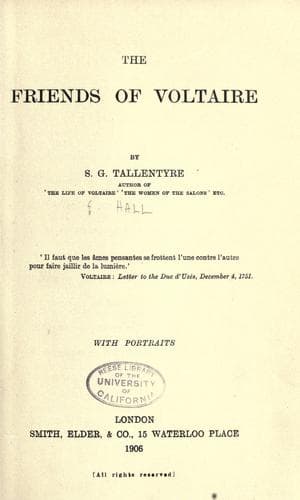
France -- Biography; Voltaire, 1694-1778 -- Friends and associates
In 1770, when he was twenty-seven, he went with d’Alembert to stay at
Ferney. Voltaire was delighted with him. Here was a man after his own
heart, with his own hatred of oppression and fanaticism and his own zeal
for humanity, with better chances of serving it! The Patriarch did not
add, as he might have added, that this young Condorcet had a thousand
virtues a Voltaire could never compass--that he was pure in life and
hated a lie; that he was wholly without jealousy, without vanity, and
without meanness. Caritat soon worshipped at the feet of a master of
whom his friendship with d’Alembert had already proclaimed him a pupil,
while Voltaire enlisted his guest’s quiet, practical help for the
rehabilitation of the Chevalier de la Barre, for the revision of the
process of d’Étallonde; and honoured him by becoming his editor and
assistant in the critical ‘Commentary on Pascal’ which Condorcet
produced later.
Because his humility was the humility of a just mind and his modesty of
the kind that scorns to cringe, Condorcet’s admiration for his host did
not blind him to his literary faults or make him meanly spare them; and
while it was Condorcet who spoke in warm eulogy of his ‘dear and
illustrious chief’ as working not for his glory but for his cause, it
was also Condorcet who deprecated that production of Voltaire’s
senility, ‘Irène.’ Sometimes the three friends would talk over the
future of France--the two older men who had done much to mould that
future and the young man who had much to do. ‘You will see great days,’
old Voltaire wrote afterwards to his guest; ‘you will make them.’
The visit lasted a fortnight, and was a liberal education indeed.
Three years later, in 1773, Condorcet received the crown of his success
as a mathematician and was made Perpetual Secretary of the Academy of
Sciences, where he wrote _éloges_ of the savants who had belonged to it,
with the noble motto for ever in his mind, ‘One owes to the dead only
what is useful to the living--justice and truth.’
So far, Condorcet had been a mathematician alone. Knowledge might free
and redeem the world--in time; but the time was long. Beneath that quiet
exterior, palpitating through his leisurely, exact studies at the
College of Navarre and the Scientific Academy, there throbbed in this
man’s breast a vaster and fiercer passion than any passion for
learning--the passion for human-kind. Where did young Condorcet come by
that ruling idea of his that opened to him a field of labour which he
must till all his days, unremittingly, before the night cometh when no
man can work--that idea which should steel him to endure, exulting, the
cruellest torments of life and death--‘the infinite perfectibility of
human nature, the infinite augmentation of human happiness’?
The friend of d’Alembert was Condorcet, the geometrician; the friend of
Turgot was Condorcet, the reformer.
Public-domain text, read in full here on John Shaqi.
Reviews
Reviews
No reviews yet
Be the first to share your thoughts on this work.
Elsewhere in the archive
Join the Discussion
Join the discussion
Sign in to leave a comment or review.
Sign InorCreate an account