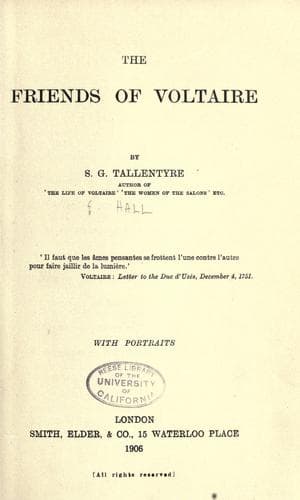
France -- Biography; Voltaire, 1694-1778 -- Friends and associates
In August, 1774, Turgot was made Controller-General. He appointed
Condorcet his Inspector of Coinage at a salary of 240_l._ a year, a
payment which Condorcet never accepted.
The pair had work to do, which only they could do, and do together. The
vexed subject of Trade in Grain--‘for a moment,’ says Robinet, ‘the
whole question of the Revolution lay in this question of Grain’--incited
them to fierce battle for what they took to be the cause of freedom
against the cause of that well-meaning commonplace, Necker. Condorcet
attacked Necker with a rare, fierce malignity, and wrote two stinging
pamphlets on the subject which made him many enemies.
But there were other reforms waiting the doing, less in importance then
and greater in importance now. To curtail the advantages of the
privileged classes, to open for commerce the rivers of central France,
to abolish the slave trade, _Taille_ and _Corvée_, _Vingtième_ and
_Gabelle_, and to make the nobility share in the taxation--these were
the tasks into which this noble put his life and his soul. That every
reform meant loss to himself, that all his interests were vested in the
privileges he sought to destroy, that every human tie drew him towards
the old order, makes his work for the new, more excellent than that of
his fellow-workers. They had nothing to gain; Condorcet had everything
to lose.
In May, 1776, a Queen of one-and-twenty demanded that ‘le sieur Turgot
fût chassé, même envoyé à la Bastille’; and, in part, she had her way,
for her own ruin and that of France. Condorcet renounced his
Inspectorship of Coinage; he would not serve under another master.
Turgot’s death in 1781 was the first great sorrow of his life. His other
friend, d’Alembert, won for him a seat in the French Academy in 1782;
and in the next year he too died. Condorcet tended him to the last, with
that quiet and generous devotion which says little and does much.
D’Alembert left to him the task of providing annuities for two old
servants, and Condorcet accepted the obligation as a privilege, and
fulfilled it scrupulously in his own poverty and ruin.
He was now not a little lonely. His relatives still resented his choice
of a profession; his best friends were dead; the great Master of their
party had preceded them. From ‘social duties falsely so called’ Caritat
had long ago freed himself. He was three and forty years old, occupied
in writing that ‘Life of Turgot’ which is a declaration of his own
principles and policy, in contributing to the Encyclopædia, and in many
public labours, when he first met Mademoiselle Sophie de Grouchy.
Public-domain text, read in full here on John Shaqi.
Reviews
Reviews
No reviews yet
Be the first to share your thoughts on this work.
Elsewhere in the archive
Join the Discussion
Join the discussion
Sign in to leave a comment or review.
Sign InorCreate an account