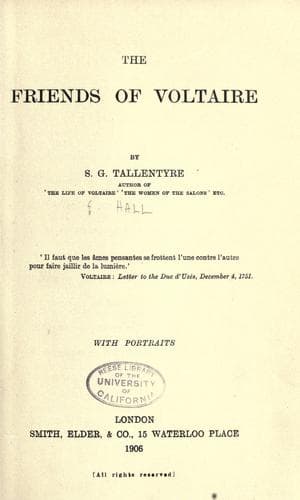
France -- Biography; Voltaire, 1694-1778 -- Friends and associates
If the supreme blessing of life be a happy marriage, then Condorcet was
a fortunate man indeed. Mademoiselle was full twenty years younger than
himself, very girlish in face and figure, with a bright cultivated
mind, and a rare capacity for love and tenderness. He found in her what
is uncommon even in happy marriages perhaps--his wife was also his
friend. From the first she shared his work and his love for his
fellow-men, approved of his sacrifices, and was true not only to him,
but to his example of unselfish courage and unflinching devotion, to the
end of her life.
For the moment--for what a brief moment!--their world looked smiling
enough.
Condorcet abandoned himself to his happiness, with the deep passion of a
strong man who has never wasted his heart in lighter feelings. For a
dowry--so essential to a French marriage--he wholly forgot to stipulate.
For the opinion of his friends, who considered a married geometrician as
a sort of freak of Nature, he cared nothing; and when they saw his wife,
and forgave him, their pardon was as little to him as their blame.
The two settled on the Quai de Conti in a house where Caritat had
previously lived with his mother. At that Hôtel des Monnaies Sophie held
her _salon_ (_le foyer de la République_, men called it), where she
received, with a youthful charm and grace, not only her husband’s French
political friends, but also Lord Stormont the English Ambassador,
Wilkes, Garrick, Sterne, Hume, Robertson, Gibbon, Mackintosh, and Adam
Smith.
Large and shy, with a little awkwardness even in his manner, it was not
Condorcet but his wife who was socially successful. She was the one
woman in a thousand who estimated social success at its low, just value,
and was great in knowing her husband to be much greater.
Only two years after their marriage, in 1788, Condorcet entered the
arena as one of the earliest and most noteworthy of all champions of
Women’s Rights. On the ground of their equal intelligence he claimed for
them equal privileges with men, and ignored the very suggestion that
their bodily weakness and inferiority are reproduced in their minds. He
judged, in fact, all women from one woman. No nobler testimony can be
borne to the intellect and character of the Marquise de Condorcet than
to say that she deserved as an individual what her example made her
husband think of her sex.
It is not a little curious to note that Condorcet, though so wholly
faithful and happy himself in the relationship, thought the
indissolubility of marriage an evil. In later years, he pleaded warmly
for the condemnation of mercenary marriages by public opinion, as one of
the best means of lessening the inequalities of wealth.
Public-domain text, read in full here on John Shaqi.
Reviews
Reviews
No reviews yet
Be the first to share your thoughts on this work.
Elsewhere in the archive
Join the Discussion
Join the discussion
Sign in to leave a comment or review.
Sign InorCreate an account