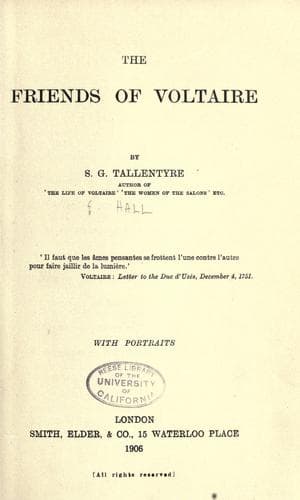
France -- Biography; Voltaire, 1694-1778 -- Friends and associates
One graceless hanger-on turned back as he was leaving him one day. ‘M.
Diderot, do you know any natural history?’ ‘Well,’ says Diderot, ‘enough
to tell a pigeon from a humming-bird.’ ‘Have you ever heard of the
_Formica leo_? It is a very busy little creature; it burrows a hole in
the earth like a funnel, covers the surface with a fine sand, attracts
a number of stupid insects to it, takes them, sucks them dry, and says,
“M. Diderot, I have the honour to wish you a very good morning.”’ It may
be said of Diderot that he could love, but not respect; and that is the
inevitable attitude one takes towards himself.
In 1755, during his work at the Encyclopædia and for those innumerable
idle persons who had much better have worked for themselves, poor
Nanette went on a second fatal visit to Langres and gave her husband the
opportunity of falling in love with Mademoiselle Volland, and starting a
memorable correspondence.
Sophie Volland was a rather elderly young lady, with spectacles, and a
good deal of real cleverness and erudition. Whether Diderot, who was now
a man of forty-two, was ever literally in love with her, or whether he
was ‘less than lover but more than friend,’ remains uncertain. His
letters to her are warmly interesting, frank, natural, spontaneous, with
many passages of exquisite beauty and thoughtfulness. There is but one
fault--that fatal fault without which Diderot would not have been
Diderot at all but some loftier man--his irrepressible indecency.
He had much to tell Mademoiselle. The words seem to trip over each other
in his anxiety to show her all he had done and felt. He was now famous.
The Encyclopædia had thrown open to him, cutler’s son though he was, the
doors of the _salons_; a great quarrel he had with Eousseau in 1757--the
dingy details of which there is neither interest nor profit in
recalling--made him the talk of the _cafés_.
But this loud, explosive Denis was scarcely a social light. He said
himself that he only liked company in which he could say anything. And
what Diderot meant by _anything_ was considered indecorous even in that
freest of all free-spoken ages. Good old Madame Geoffrin lost her
patience with him, not only for his licence, but for talking so movingly
about duty and neglecting all his own. _She_ was not going to ignore his
Mademoiselle Volland. She treated him ‘like a beast,’ he said, and
advised his wife to do the same. As for Madame Necker--‘qui raffole de
moi,’ said the complacent Denis himself--she too ‘judged great men by
their conduct and not by their talents,’ which was very awkward indeed
for a Diderot.
Public-domain text, read in full here on John Shaqi.
Reviews
Reviews
No reviews yet
Be the first to share your thoughts on this work.
Join the Discussion
Join the discussion
Sign in to leave a comment or review.
Sign InorCreate an account