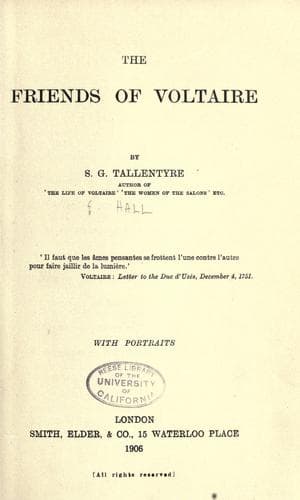
France -- Biography; Voltaire, 1694-1778 -- Friends and associates
When ‘Money’ was finished, he read it to Monseigneur, without mentioning
its authorship. ‘Why do not _you_ give your mind to serious works such
as that?’ said the King’s chaplain, and praised the thing extravagantly.
When Galiani told his secret, Monseigneur was so delighted that he at
once set to work at Court to procure this promising nephew something
really worth having. At two-and-twenty years old, having never studied
theology and having taken minor orders only, and with the sole object of
obtaining these emoluments, Galiani found himself the possessor of the
benefice of Centola and the abbey of Saint-Laurent, while a
dispensation from Rome gave him the title of Monseigneur and the honour
of the mitre. Soon after, the admiring Court of Naples also presented
him with the rich abbey of Saint Catherine of Celano.
The wonder is, not that Galiani writhed with laughter (like the little
Punchinello his friends dubbed him) when he alluded to the religion of
his fathers, but that to the end of his days he saw in that religion,
beneath its shameless venality and its hideous moral corruptions, some
saving truth to bless and comfort man’s soul. When all Paris laughed at
the credulity of Madame Geoffrin, whose death was said to have been
brought about from over-devotion to her religious duties, it was Galiani
who wrote that he considered that unbelief was ‘the greatest effort the
mind of man could make against his natural instincts and wishes.... As
the soul grows old, belief reappears.’ Unlike nearly all his philosophic
friends, if his own illusions were few, he was careful to leave
undisturbed those of happier people.
In respect to the emoluments he received from Rome, and on which he
fattened all his life, it may be justly said that he took them as a man
takes a fortune out of a business he knows to be rotten, congratulating
himself on his own perspicacity, and believing that beneath the
rottenness there still lies the making of a true and honest enterprise.
The Neapolitan Government having adopted all the ideas suggested in
‘Money,’ the fortunate young gentleman who had written it started off in
excellent spirits, in November 1751, for Rome, Florence, and Venice. The
Pope, and all the grandees, _savants_, and _littérateurs_ in Italy
petted and made much of the agreeable little prodigy.
Public-domain text, read in full here on John Shaqi.
Reviews
Reviews
No reviews yet
Be the first to share your thoughts on this work.
Join the Discussion
Join the discussion
Sign in to leave a comment or review.
Sign InorCreate an account