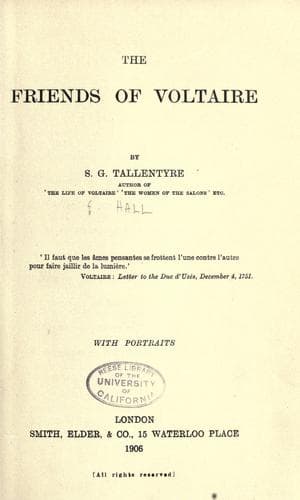
France -- Biography; Voltaire, 1694-1778 -- Friends and associates
Presently the King of Naples gave him yet two more posts--entailing not
only emoluments but work--and he resumed his literary labours, wrote a
pamphlet on the ‘Instincts and Habitual Tastes of Man,’ a comic opera,
to Paisiello’s music, called ‘The Imaginary Socrates,’ and another most
amusing pamphlet, written in a single night, to distract the Neapolitans
from their fright on the eruption of Vesuvius in 1779.
In 1781 he visited Rome, and was courted by all the great people; and
when he came home Naples gave him another rich abbey and another most
lucrative civil appointment. He was still a comparatively young man.
Fortune had overturned her horn at his feet. ‘The torment of all things
accomplished, the plague of nought to desire,’ might well have been
Galiani’s. But he had the rare power of finding happiness where it most
often hides--in small and common things. The monkey which had amused his
leisure he had replaced by a couple of cats, and it afforded him
infinite amusement to watch their gambols and their habits, and write
long dissertations on the natural history of the animal to Madame
d’Épinay in Paris.
His friendship with her had lasted without break or blot for nearly
five-and-twenty years. If happiness meant only exemption from suffering,
then well for Galiani that no woman ever held his heart more nearly than
this light, bright, irresponsible little person. But that side of
existence which brings the deepest sorrow brings too the highest joy,
and who is spared the first, misses the second. Madame Daubinière had
touched neither his soul nor his life; Madame d’Épinay only aroused a
capacity for a friendship which, as he loved no one, had certainly
assumed some of the absorption of a passion. When she died in 1783, he
stood in the presence of a great and a most genuine sorrow. She had
represented the Paris he would see no more; to answer her letters had
been a large occupation in his life--and she was dead! He turned to his
work as his last hope, to the one means that was left of making life
endurable. In 1785 he was attacked by apoplexy, and two years later he
travelled for his health. But it was not improved. ‘The dead are so
bored,’ he said in his old jesting manner; ‘they have asked me to come
and cheer them a little.’
Public-domain text, read in full here on John Shaqi.
Reviews
Reviews
No reviews yet
Be the first to share your thoughts on this work.
Join the Discussion
Join the discussion
Sign in to leave a comment or review.
Sign InorCreate an account