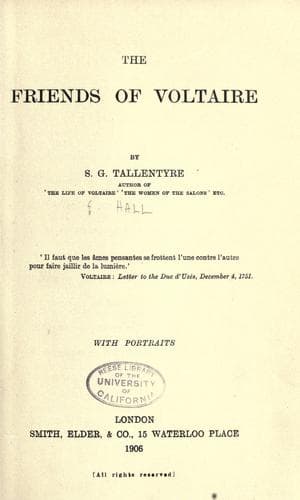
France -- Biography; Voltaire, 1694-1778 -- Friends and associates
His first campaign was in Italy in 1733 with Marshal Villars, who was on
his last. Italy! the land of dreams! The boy was filled with splendid
visions of following Hannibal across the mountains--with young sanguine
hopes of gloriously doing his duty and meeting immediate, glorious
rewards. For three years he knew the intoxication--and the horrors--of a
victorious campaign. And then of a sudden he found himself condemned at
one-and-twenty to the vicious idleness, the low pleasures, and the
deadening routine of a garrison life. The rich officers were of course
drawn by that magnet, the Court, to keep up their military studies and
prepare for the next war by dancing attendance on women and flattering
the Minister and the King at Versailles. The poor ones remained on
duty--with not enough of it to keep them out of mischief, and with, for
the most part, debased tastes, because their intellectual limitations
precluded them from higher.
The contamination of that useless existence even a Vauvenargues did not
wholly escape. For a brief while he was as other men are. But the
pleasures of a garrison town could not long hold such a nature as his.
Already--he was but twenty-two--he had that love of solitude which,
says a great German philosopher, is welcomed or avoided as a man’s
personal value is great or small. Already--at an age when other men
scarcely realise they have a soul--this man was dominated by the idea of
its value and dignity; and deep within him was the passion and
resolution to exercise to the full its powers and possibilities.
With his companions he was wholly simple, natural, and friendly--without
the faintest taint of that conscious superiority which makes many good
people at once useless as a moral influence and objectionable as
companions. ‘Father,’ his brother officers used to call him. Marmontel
said ‘he held all our souls in his hands.’ He soon resumed, by
correspondence, his friendship with Victor Mirabeau; and in their
discussions on love--the view he takes of this passion is always a sure
test of a man’s character--each letter-writer showed the yawning gulf
that divided him from the other.
If Vauvenargues ever met the woman worthy to hold his heart, to be, in
the finest and highest understanding of those words, his companion and
completion, is not known. He writes of love as if he had felt it. But to
some pure souls--as to a Milton and a St. John the Divine--are revealed
in visions the Eden and the New Jerusalem wherein they never walked.
Vauvenargues’ letters to Mirabeau treat of the subject with such an
exquisite dignity and refinement--with such noble silences--that there
is at least no doubt that if he never found the woman who would have
realised his ideals, he was spared the bitterness of loving one who
broke them.
Public-domain text, read in full here on John Shaqi.
Reviews
Reviews
No reviews yet
Be the first to share your thoughts on this work.
Join the Discussion
Join the discussion
Sign in to leave a comment or review.
Sign InorCreate an account