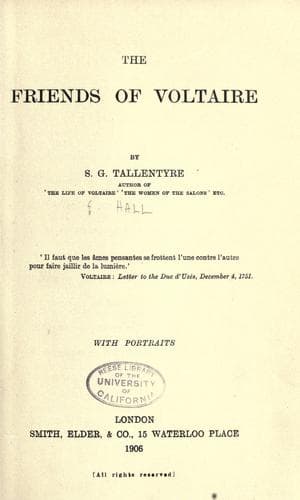
France -- Biography; Voltaire, 1694-1778 -- Friends and associates
Who reads ‘The System of Nature’ now? It never was in any sense a great
book. But it certainly was one of the three or four most famous books of
an age richer in them than any other age in history. It was, after all,
simply the logical outcome, the natural, though the extreme result of
the rationalistic criticism of the fifty or sixty years which preceded
it. The philosophers had sought to define God. D’Holbach said aloud,
what the fool of David’s time said in his heart, ‘THERE IS NO GOD.’
In Part I. he disposed of Kings as effete, luxurious, war-making, and
tyrannical. Then he expounded his views on Happiness. Men will never be
happy till they are enlightened, and never enlightened till they have
ceased to believe in a God. Study Nature, and obey Nature’s laws--that
is the way to felicity, if way there be. Then he went on to Mind. All
Mind is Matter. Of Free Will he denied the existence, as twelve years
earlier his friend Helvétius had denied it in his book ‘On the Mind.’
Still, even if one cannot help one’s wrong-doing, punishments there must
be, for the good of society; only such punishments should be reformative
and never cruel. In his protest against torture and the brutalising
effect of public executions, one sees for a moment the man behind the
book. With regard to the Immortality of the Soul, since there is no such
thing as soul, it cannot be immortal. The false doctrine of Hell is
useless even as a deterrent from sin.
Part II. contains what is certainly the most burning and outspoken
attack on the Existence of God to be found in literature. That there is
a Force behind Matter, I admit. He who does not admit this, must be a
madman. But further I will not go. As for morality depending on a belief
in a Deity--not at all. Nature bids man do right as his own best
interest. Let each try to do his utmost for the greatest good of the
greatest number, and there stands established a high and an unselfish
ideal.
Preached, as these doctrines were, in a style not a little vehement and
abundant, with much Teutonic pomposity and rhetoric, it could soon be
said of d’Holbach that he had ‘accommodated atheism to chambermaids and
to hairdressers.’ More learned critics disliked his manner as much as
his matter. ‘Four times too many words in the book,’ says Voltaire
acidly. But the uneducated, or the half-educated, prefer both their
oratory and their literature rich and fruity.
Public-domain text, read in full here on John Shaqi.
Reviews
Reviews
No reviews yet
Be the first to share your thoughts on this work.
Elsewhere in the archive
Join the Discussion
Join the discussion
Sign in to leave a comment or review.
Sign InorCreate an account