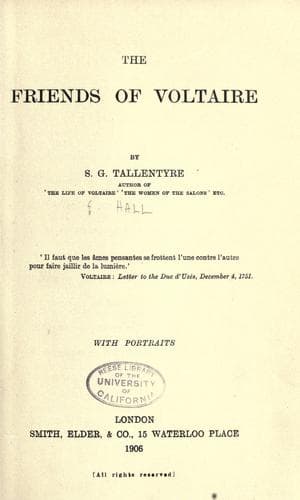
France -- Biography; Voltaire, 1694-1778 -- Friends and associates
Simple and learned alike would, or should, had they known him, have
given the author credit for the certain fact that ‘no sordid end, no
personal consideration, attached him to his dismal system.’ If his
anonymity shielded him from danger, it kept from him fame and celebrity
too, and gave him the wholesome, but not soothing, experience of hearing
expressed to his face criticisms of the kind generally only made behind
one’s back. He did not gain even the painful glories of martyrdom; and
had money been an object to him, by the publication of such works as
his, he can only have lost it.
Long before the tumult ‘The System of Nature’ raised had passed away,
the Baron was busy supplementing it. In 1772 appeared ‘Good Sense, or
Natural Ideas opposed to Supernatural Ideas,’ which was a sort of
simplification of ‘The System of Nature.’ It was burnt. Then appeared
‘The Social System,’ which tried to establish a rule of morality totally
unfounded on religion. That was burnt too. Then there was a translation
from Hobbes. The last, or one of the last, of d’Holbach’s published
works was entitled ‘Universal Morality, or the Duties of Man founded on
his Nature.’ This appeared in 1776. He had the pleasure of watching all
the bonfires from a distance where there was not the least danger of
scorching.
In 1781 one of his daughters was married. Her father was now
fifty-eight years old. Did philosophy, as Galiani inquired (Galiani had
returned to Italy in 1769), still eat at his table with its old
appetite? Grimm said--in Grimm’s caustic fashion--that the guests fell
off somewhat when the Baron had to retrench his expenses to establish
his children. Some of the _convives_ had gone before that, to solve for
themselves those questions on a future world, and the existence of the
soul, which they had discussed so often. In 1771 died Helvétius; in 1778
Voltaire himself. In 1783, d’Alembert, who had indeed long ceased to
frequent the Baron’s society, or any society, laid down the burden of
his life. In the next year, Diderot, the friend of his heart, the
fruitful inspiration of his work, was called away from d’Holbach’s side
for ever.
It must have been with this society, as it is with all societies at
last: the sight of vacant chairs stops the mirth, and among the living
guests glide others, dear and dead. When one has more memories than
hopes, the time has come to give up such gatherings. That time came even
to _the_ Host of his generation. By his own fireside he had to the end
the wife he loved. She long survived him. He had, too, that tranquil and
even disposition which is surely one of the best of assets--a possession
indeed.
Public-domain text, read in full here on John Shaqi.
Reviews
Reviews
No reviews yet
Be the first to share your thoughts on this work.
Elsewhere in the archive
Join the Discussion
Join the discussion
Sign in to leave a comment or review.
Sign InorCreate an account