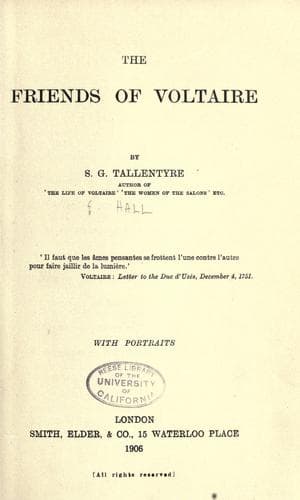
France -- Biography; Voltaire, 1694-1778 -- Friends and associates
It set out to prove a new theory of human action, and a new system of
morality. Virtue and vice? There are no such things. Self-interest,
rightly understood, is the explanation of the one, and self-interest,
misunderstood, of the other. Selfishness and the passions are the sole
mainsprings of our deeds. So far from character being destiny, as
Novalis is to declare, destiny is in all cases character. Everybody is
the creature of his environment and his education. Free Will? What free
will to be an honest man has the child of thieves, brought up to thieve
in a slum? Change his condition, and you change him. Leave him, and he
will steal as certainly as fire burns and the waves beat on the shore.
As for the vaunted superiority of the human intelligence over the
brutes, ‘an accident of physical organisation’ can account for that. We
are _as_ the brutes, only a little better, and the difference is wholly
of degree, not of kind.
Put these theories, with their showy falsehood and their substratum of
truth, on the library table of any clever man, and get him to do his
best to prove them by sophistry and ingenuity, by trick, by subterfuge,
by illustration--somehow, anyhow, so that he prove them to the hilt--and
the result will be pretty well what Helvétius made it. There was
scarcely a good story, or a bad one, he had heard in his early gay life
in Paris that he did not bring in, by hook or by crook, to point and
enliven his paradox. Madame de Graffigny told Bettinelli that nearly all
the notes were the ‘sweepings’ of her _salon_.
‘On the Mind’ is entertaining or nothing--difficulties presented solely
that they may be wittily demolished--easy, inaccurate, trifling; a style
‘insinuating and caressing ... made for light minds, young people and
women,’ says Damiron; a book which fashion might skip at its toilette,
and then, on the strength of remembering two or three of its dubious
anecdotes, claim a complete knowledge of its _bizarre_ philosophy. For
it was but a _bizarrerie_--a _jeu d’esprit_--and Helvétius knew it. He
was merely concerned to see how far his impossible theories could be
made plausible, and wrote them to catch the public ear, and turn their
author into the lion and darling of the season.
When the thing was ready he took it to Tercier, the censor, who passed
it, suggesting only the omission of a few too complimentary references
to free-thinking Hume. Helvétius cut them out. Malesherbes, during its
printing, observed uneasily that the book contained ‘some very strong
things’--insolent remarks, for instance, on that dear, crusted old
despotism under which we all live, and certainly a suggestion that any
means to overthrow tyranny are permissible. But, all the same, in May
1758 it received its privilege. Majesty was graciously pleased to accept
a copy from the author, our _maître d’hôtel_. It was already in the
hands of the philosophers. And everybody began to read.
Public-domain text, read in full here on John Shaqi.
Reviews
Reviews
No reviews yet
Be the first to share your thoughts on this work.
Elsewhere in the archive
Join the Discussion
Join the discussion
Sign in to leave a comment or review.
Sign InorCreate an account