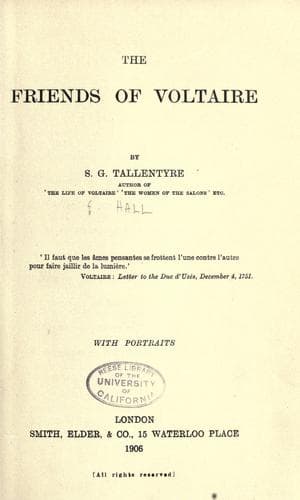
France -- Biography; Voltaire, 1694-1778 -- Friends and associates
It would not have been wonderful, if the theories had had a little more
_vraisemblance_, that most people, particularly people who had devoted
their lives and their fortunes to others, who had laboured in poverty
that other men might be free and rich, should object to see their
self-denial set down as self-interest, and to be informed that the
highest aspiration of their soul was really nothing but a morbid
condition of the body. But, considering their manifest absurdity, it is
wonderful that these assertions were taken seriously.
Madame du Deffand, indeed, might naturally say that in making
self-interest the mainspring of conduct, Helvétius had revealed
everybody’s secret. He had so certainly discovered hers. But Turgot,
whose life was to do good, had better have laughed at an absurdity than
have risen up to condemn it as ‘philosophy without logic, literature
without taste, and morality without goodness.’ A Condorcet, whose long
devotion to duty was rewarded only with ruin and death, need not have
troubled to loathe it. Rousseau immediately sat down to refute it: some
of the most inspired pages of his ‘Savoyard Vicar’ still glow with the
hatred with which it inspired him. Grimm wisely only pooh-poohed it.
Voltaire grumbled that his pupil had promised a book on the Mind, and
presented a treatise on Matter; that he had ‘put friendship among the
bad passions,’ and, much worse than all, has actually compared
_me_--ME--to two such feeble, second-rate luminaries as Crébillon and
Fontenelle! No wonder that he found the title, ‘De l’Esprit,’ equivocal,
the matter unmethodical, all the new things false and all the old ones
truisms.
For a very short time, however, approved or disapproved, taken as folly
or mistaken for reason, the book went its way gaily. It bade fair to
become what Helvétius had meant it to be--the success of a season. But
for the besotted stupidity of the Government, it never would have been
anything else.
One unlucky day the Dauphin, who was more virtuous than wise, came out
of his room with a copy in his hand and fury in his face. ‘I am going to
show the Queen the sort of thing her _maître d’hôtel_ prints.’
On August 10, 1758, the privilege for its publication was revoked.
Tercier was deprived of his office. ‘On the Mind’ was furiously attacked
in the religious papers. The _avocat général_, Fleury, pronounced it ‘an
abridgment of the Encyclopædia.’ The Archbishop of Paris declared it
struck at the roots of Christianity. At Court, Helvétius was all at once
‘regarded as a child of perdition, and the Queen pitied his mother as if
she had produced Anti-Christ.’ Rome banned the accursed thing. On
January 31, 1759, the Pope attacked it with his own hand in a letter. On
February 6 the Parliament of Paris condemned it. On February 10 it was
publicly burned by the hangman, with Voltaire’s ‘Natural Law.’ On April
9 the Sorbonne censured it, and declared it to contain ‘the essence of
the poisons’ of all modern literature.
Public-domain text, read in full here on John Shaqi.
Reviews
Reviews
No reviews yet
Be the first to share your thoughts on this work.
Elsewhere in the archive
Join the Discussion
Join the discussion
Sign in to leave a comment or review.
Sign InorCreate an account