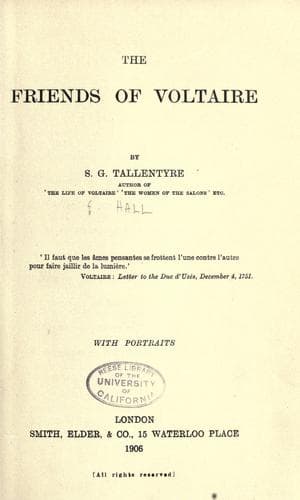
France -- Biography; Voltaire, 1694-1778 -- Friends and associates
Helvétius, from being the happiest of easy-going, benevolent
philosophers, found himself, as it were in a second, in a position of
great danger, and what Collé in his Journal called ‘cruel pain.’ His
friends hotly urged upon him a retractation to soften the certain
punishment awaiting him. His mother begged it from him with tears. Only
Minette, a sterner and a braver soul, refused, though ‘a great
personage’ besought her, to add her own entreaties to that end.
Still, it had to be done. Something of a coward this Helvétius, as Collé
suggested now, as Diderot had suggested before? The rich and easy life
he had led does not breed courage certainly. But, after all, Helvétius
only did what Voltaire and many a better man declared it was essential
to do in that day. He produced a ‘Letter from the Reverend Father ...
Jesuit,’ in which he stated that he had written in perfect innocence and
simplicity, and (this was undoubtedly true) that he had not had the
slightest idea of the effect his book would create. He added, in the
stiff phraseology of the time, words to the effect that he was an
exceedingly religious man and very sorry indeed. The _amende_ was so far
accepted that the Parliament simply condemned him to give up his
stewardship, and exiled him for two years to Voré.
What the book could never have done for itself, or for its author,
persecution did for them both. ‘On the Mind’ became not the success of a
season, but one of the most famous books of the century. The men who had
hated it, and had not particularly loved Helvétius, flocked round him
now. Voltaire forgave him all injuries, intentional or unintentional.
‘What a fuss about an omelette!’ he had exclaimed when he heard of the
burning. How abominably unjust to persecute a man for such an airy
trifle as that! ‘I disapprove of what you say, but I will defend to the
death your right to say it,’ was his attitude now. But he soon came, as
a Voltaire would come, to swearing that there was no more materialism in
‘On the Mind’ than in Locke, and a thousand more daring things in ‘The
Spirit of Laws.’ Turgot and Condorcet forgave the philosophy, in their
pity for the philosopher. D’Alembert made common cause with the man with
whom he had nothing else in common. Rousseau instantly stopped writing
his refutation. Diderot roundly swore ‘On the Mind’ was one of the great
books of the age. Though Rome had censured it, cardinals wrote to
condole with its author on the treatment it had received. It was
translated into almost all European languages. Presently, England
published an edition of her own. And Helvétius, when that two years’
exile--a punishment surely only in name?--was over, returning to Paris,
found himself the most distinguished man in the capital.
Public-domain text, read in full here on John Shaqi.
Reviews
Reviews
No reviews yet
Be the first to share your thoughts on this work.
Elsewhere in the archive
Join the Discussion
Join the discussion
Sign in to leave a comment or review.
Sign InorCreate an account