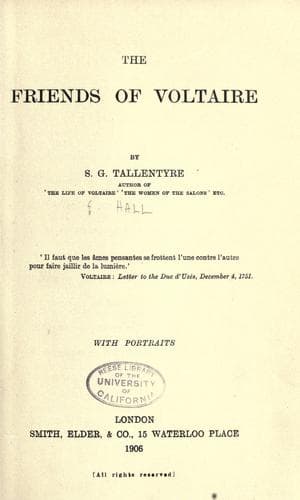
France -- Biography; Voltaire, 1694-1778 -- Friends and associates
In their fine hotel in the Rue Sainte-Anne (Rue Helvétius, the
municipality of 1792 rechristened it, and Rue Saint-Helvétius, the
_cochers_ of Paris!) he and his wife received the flower of French
society. Turgot introduced to them Morellet, who soon became a daily
visitor, rode with them in the Bois, and stayed with them in the
country. To their Tuesday dinners at two o’clock came Condorcet,
d’Alembert, Diderot, d’Holbach, Galiani, Marmontel, Saint-Lambert,
Raynal, Gibbon, and Hume--‘the States-General of the human mind,’ says
Garat. Only time-serving Buffon, in order not to offend the Court, gave
up visiting at the house. If Galiani found the religious, or
irreligious, views of the _salon_ too free, Madame his hostess shared
his opinion, and would often purposely disturb a too daring conversation
by drawing aside one of the coterie to talk with her _à part_. Helvétius
himself was still, as he had ever been, listener rather than talker; or
talker chiefly when he laid before his friends, with a _naïveté_ and
simplicity wholly at variance with the sophistry and artificiality of
his writing, the difficulties he had encountered in it that morning, or
some theories which it had suggested.
Sometimes, directly dinner was over, he slipped out to the opera, and
left his wife to do the honours alone. When they were not entertaining
themselves, they rarely went out, unless it were on Fridays to Madame
Necker’s. ‘Jealous of his wife,’ said acid Grimm, accounting for this
unsociability. ‘Happy with her,’ is perhaps a truer solution.
But if their own _entourage_ was thus satisfactory, the Court was still
bitterly hostile. Though Helvétius, of course, knew very well that that
hostility had been the advertisement to which his book owed everything,
still, its injustice rankled.
Admiring England invited him to her shores; and on March 10, 1764, he
landed there, accompanied by his two daughters, Elizabeth and Geneviève,
who, being only ten and twelve years respectively, were certainly rather
young for their father to be seeking husbands for them among ‘the
immaculate members of our august and incorruptible senate,’ as Horace
Walpole declared that he was.
Public-domain text, read in full here on John Shaqi.
Reviews
Reviews
No reviews yet
Be the first to share your thoughts on this work.
Elsewhere in the archive
Join the Discussion
Join the discussion
Sign in to leave a comment or review.
Sign InorCreate an account