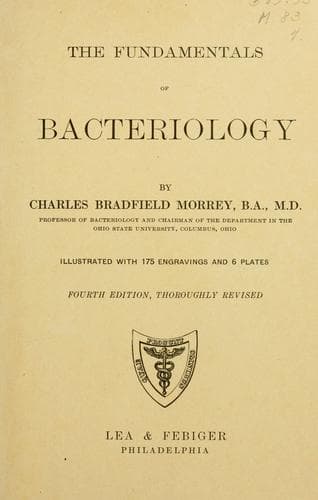
The Fundamentals of BacteriologyMorrey, Charles Bradfield
Science
The Fundamentals of Bacteriology
Morrey, Charles Bradfield
Bacteriology
His pioneer experiments made modern surgery
possible. In this year also, Pasteur was sent to investigate a disease,
Pebrine, which was destroying the silkworms in Southern France. He
showed the cause to be a protozoan which had been seen previously by
Cornalia and described by Nägeli under the name _Nosema bombycis_ and
devised preventive measures. This was the _first infectious disease_
shown to be _due to a protozoan_. In 1866 Rindfleisch observed small
pin-point-like bodies in the heart muscle of persons who had died
of wound infection. Klebs, in 1870-71, published descriptions and
names of organisms he had found in the material from similar wounds,
though he did not establish their causal relation. Bollinger, in
1872, discovered the spores of anthrax and explained the persistence
of the disease in certain districts as due to the resistant spores.
In 1873 Obermeier observed in the blood of patients suffering from
recurrent fever long, flexible spiral organisms which have been named
_Spirochæta obermeieri_. Lösch ascribed tropical dysentery to an ameba,
named by him _Amœba coli_, in 1875. Finally, Koch, in 1876, isolated
the anthrax bacillus, worked out the life history of the organism
and reproduced the disease by the injection of pure cultures and
recovered the organism from the inoculated animals, thus establishing
beyond reasonable doubt its causal relationship to the disease. This
was the _first instance of a bacterium_ proved to be the cause of a
_disease in animals_. Pasteur, working on the disease at the same time,
confirmed all of Koch’s findings, though his results were published
the next year, 1877. Bollinger determined that the _Actinomyces bovis_
(_Streptothrix bovis_) is the cause of actinomycosis in cattle in
1877. Woronin in the same year discovered a protozoan (_Plasmodiophora
brassicæ_) to be the cause of a disease in cabbage, the _first proved
instance of a unicellular animal causing a disease in a plant_. In 1878
Koch published his researches on wound infection in which he showed
beyond question that microörganisms are the cause of this condition,
though Pasteur in 1837, had suggested the same thing and Lister had
acted on the theory in preventing infection.
These discoveries, especially those of Koch, immediately attracted
world-wide attention and stimulated a host of workers, so that within
the next ten years most of the bacteria which produce disease in
men and animals were isolated and described. It is well to remember
that the first _specific_ disease of man proved to be caused by a
_bacterium_ was _tuberculosis_, by Koch in 1882.
Progress was greatly assisted by the introduction of anilin dyes as
suitable stains for organisms by Weigert in 1877, by Koch’s application
of special technic and gelatin cultures for isolation and study, 1881,
and the great improvements in the microscope by Prof. Abbé, of Jena.
Public-domain text, read in full here on John Shaqi.
Reviews
Reviews
No reviews yet
Be the first to share your thoughts on this work.
Join the Discussion
Join the discussion
Sign in to leave a comment or review.
Sign InorCreate an account