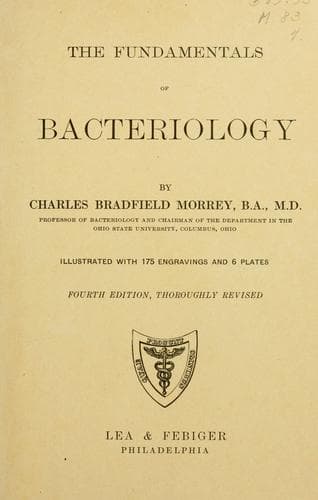
The Fundamentals of BacteriologyMorrey, Charles Bradfield
Science
The Fundamentals of Bacteriology
Morrey, Charles Bradfield
Bacteriology
Laveran’s discovery of the malarial parasite in 1880 turned attention
to protozoa as the causes of disease and led to the discovery of the
various piroplasmoses and trypanosomiases in man and the lower animals.
Pasteur’s protective inoculations in chicken cholera and anthrax
directed attention to the possibility of using bacteria or their
products as a specific protective or curative means against particular
diseases. This finally led to the discovery of diphtheria antitoxin by
Behring, and independently by Roux, in 1890, a discovery which opened
up the wide field of immunity which is so persistently cultivated at
the present time.
[Illustration: PLATE IV
LOUIS PASTEUR]
While the causation of disease by bacteria has probably attracted
most attention, especially in the popular mind, it should not be
forgotten that this is but one of the numerous ways in which these
organisms manifest their activities, and in a sense it is one of
their least-important ways, since other kinds are essential in many
industries (dairying, agriculture) and processes (sewage purification)
and are even _indispensable for the very existence of all green plants
and hence of animals, including man himself_.
PUTREFACTION AND FERMENTATION.
The idea that there is a certain resemblance between some infectious
diseases and the processes of putrefaction and fermentation seems to
have originated during the discussion on spontaneous generation and
the “contagium vivum” theory which followed Leeuwenhoek’s discoveries.
Plenciz (1762) appears to have first formulated this belief in writing.
He considered putrefaction to be due to the “animalcules” and said that
it occurred only when there was a coat of organisms on the material
and only when they increased and multiplied. Spallanzani’s experiments
tended to support this view since his infusions did not “spoil” when
boiled and sealed. Appert’s practical application of this idea has been
mentioned.
Thaer, in his _Principles of Rational Agriculture_, published in the
first quarter of the nineteenth century, expressed the belief that the
“blue milk fermentation” was probably due to a kind of fungus that
gets in from the air, and stated that he had prevented it by treating
the milk cellars and vessels, with sulphur fumes or with “oxygenated
hydrochloric acid” (hypochlorous acid).
Public-domain text, read in full here on John Shaqi.
Reviews
Reviews
No reviews yet
Be the first to share your thoughts on this work.
Join the Discussion
Join the discussion
Sign in to leave a comment or review.
Sign InorCreate an account