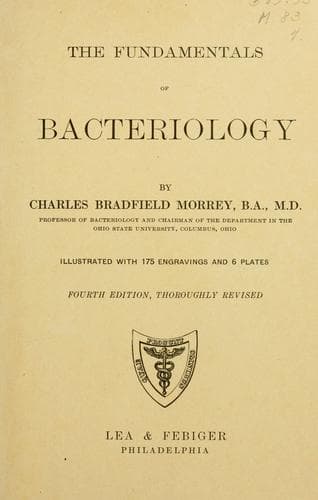
The Fundamentals of BacteriologyMorrey, Charles Bradfield
Science
The Fundamentals of Bacteriology
Morrey, Charles Bradfield
Bacteriology
A marked difference between enzymes and toxins is that the former may
bring about a very great chemical change and still may be recovered
from the mixture of substances acted on and produced, while the toxin
seems to be permanently used up in its toxic action and cannot be
so recovered. _Toxins seem very much like enzymes whose action is
restricted to living cells._
Just as enzymes are probably produced by all kinds of cells and not by
bacteria alone, so toxins are produced by other organisms. Among toxins
which have been carefully studied are _ricin_, the poison of the castor
oil plant (_Ricinus communis_); _abrin_ of the jequirity bean (_Abrus
precatorius_); _robin_ of the common locust (_Robinia pseudacacia_);
poisons of spiders, scorpions, bees, fish, snakes and salamanders.
It has been stated that some enzymes are thrown out from the cell and
others are retained within the cell. The same is true of toxins, hence
we speak of _exo-toxins_ or toxins excreted from, and _endo-toxins_
or toxins retained within the cell. Among the pathogenic bacteria
there are very few which secrete toxins when growing outside the body.
_Clostridium tetani_ or lockjaw bacillus, _Corynebacterium diphtheriæ_
or the diphtheria bacillus, _Clostridium botulinum_ or a bacillus
causing a type of food poisoning, _Pseudomonas pyocyanea_ or the blue
pus bacillus are the most important. Other pathogenic bacteria do not
secrete their toxins under the above conditions, but only give them up
when the cell is disintegrated either within or outside the body. For
the reason that endotoxins are therefore difficult to obtain, their
characteristics have not been much studied. The description of toxins
as above given is intended to apply to the _exo-toxins_ of bacteria,
sometimes spoken of as _true toxins_, and to the vegetable toxins
(phytotoxins) which resemble them.
The snake venoms and probably most of the animal toxins (zoötoxins) are
very different substances. (See Chapter XXIX.)
CAUSATION OF DISEASE.
This subject belongs properly in special pathogenic bacteriology. It
will be sufficient to indicate that bacteria may cause disease in one
or more of the following ways: (_a_) blocking circulatory vessels,
either blood or lymph, directly or indirectly; (_b_) destruction of
tissue; (_c_) production of non-specific poisons (ptomaines, bases,
nitrites, acids, gases, etc.); (_d_) production of specific poisons
(toxins).
ANTIBODY FORMATION.
Bacteria cause the formation of specific “antibodies” when properly
introduced into animals. This must be considered as a physiological
activity since it is by means of substances produced within the
bacterial cell that the body cells of animals are stimulated to form
antibodies. (See Chapters XXVI-XXIX.)
STAINING.
The reaction of bacteria to various stains is dependent on their
physico-chemical structure and hence is a result of physiological
processes, but is best discussed separately (Chapter XIX).
CULTURAL CHARACTERISTICS.
Public-domain text, read in full here on John Shaqi.
Reviews
Reviews
No reviews yet
Be the first to share your thoughts on this work.
Elsewhere in the archive
Join the Discussion
Join the discussion
Sign in to leave a comment or review.
Sign InorCreate an account