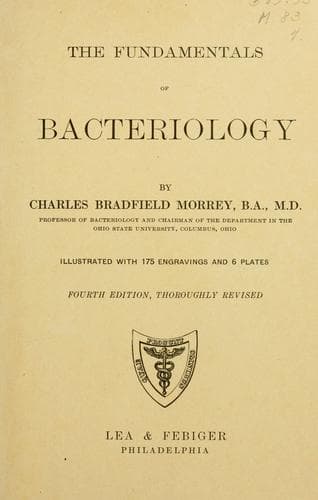
The Fundamentals of BacteriologyMorrey, Charles Bradfield
Science
The Fundamentals of Bacteriology
Morrey, Charles Bradfield
Bacteriology
The same is true of the appearance and growth on different culture
media. (Chapter XX.)
CHAPTER XIII.
DISINFECTION--STERILIZATION--DISINFECTANTS.
The discussion of the physiology of bacteria in the preceding chapters
has shown that a number of environmental factors must be properly
correlated in order that a given organism may thrive. Conversely, it
can be stated that any one of these environmental factors may be so
varied that the organism will be more or less injured, may even be
destroyed by such variation. It has been the thorough study of the
above-mentioned relationships which has led to practical methods for
destroying bacteria, for removing them or preventing their growth when
such procedures become necessary.
The process of killing all the living organisms or of removing them
completely is spoken of as _disinfection_ or as _sterilization_,
according to circumstances. Thus the latter term is applied largely in
the laboratory, while the former more generally in practice outside the
laboratory. So also disinfection is most commonly done with chemical
agents and sterilization by physical means, though exceptions are
numerous. The original idea of disinfection was the destruction of
“infective” organisms, that is, organisms producing disease in man or
animals. A wider knowledge of bacteriology has led to the application
of the term to the destruction of other organisms as well. Thus the
cheese-maker “disinfects” his curing rooms to prevent abnormal ripening
of cheese, and the dairy-worker “disinfects” his premises to avoid bad
flavors, abnormal changes in the butter or milk. _Sterilization_ is
more commonly applied to relatively small objects and _disinfection_ to
larger ones. Thus in the laboratory, instruments, glassware, apparatus,
etc., are “sterilized” while desks, walls and floors are “disinfected.”
The surgeon “sterilizes” his instruments, but “disinfects” his
operating table and room. The dairy-workers mentioned above sterilize
their apparatus, pails, milk bottles, etc. Evidently the object of the
two processes is the same, removing or destroying living organisms, the
name to be applied is largely a question of usage and circumstances.
Any agent which is used to destroy microörganisms is called a
“disinfectant.” Material freed from _living_ organisms is “sterile.”
The process of _preventing the growth_ of organisms without reference
to whether they are killed or removed is spoken of as “_antisepsis_,”
and the agent as an _antiseptic_. Hence a mildly applied “disinfectant”
becomes an “antiseptic,” though it does not necessarily follow that
an “antiseptic” may become a disinfectant when used abundantly. Thus
strong sugar solutions prevent the development of many organisms,
though they do not necessarily kill them.
Public-domain text, read in full here on John Shaqi.
Reviews
Reviews
No reviews yet
Be the first to share your thoughts on this work.
Elsewhere in the archive
Join the Discussion
Join the discussion
Sign in to leave a comment or review.
Sign InorCreate an account