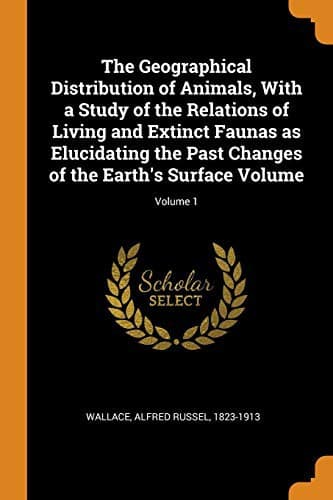
The Geographical Distribution of Animals, Volume 1: With a study of the relations of living and extinct faunas as elucidating the past changes of the Earth's surfaceWallace, Alfred Russel
Science
The Geographical Distribution of Animals, Volume 1: With a study of the relations of living and extinct faunas as elucidating the past changes of the Earth's surface
Wallace, Alfred Russel
Paleontology; Zoogeography
We commence the Artiodactyla, or even-toed Ungulates, with the hog tribe.
These are represented by species of peccaries, (_Dicotyles_) from the
Pliocene of Nebraska and Oregon; and by an allied form _Thinohyus_, very
like _Dicotyles_, but having an additional premolar tooth and a much
smaller brain-cavity. From the Miocene are three allied genera, _Nanohyus_,
_Leptochoerus_, and _Perchoerus_. Professor Cope, however, thinks
_Leptochoerus_ may be Lemuroid, and allied to _Menotherium_. The
Anthracotheridæ, a family which connects the Hippopotamidæ and Ruminants,
and which occurs in the Miocene of Europe and India, are represented in
America by the genus _Hyopotamus_ from the Miocene of Dakota, and
_Elotherium_ from the Miocene of Oregon and the Eocene of Wyoming; the
latter genus being sometimes classed with the preceding family, and lately
placed by Professor Marsh, in the new order, Tillodontia. Professor Cope
has since described three other genera from the Eocene of New {138}Mexico:
_Meniscotherium_, having resemblances to _Palæosyops_, _Hyopotamus_, and
the Limnotheridæ; _Phenacodus_, the size of a hog, of doubtful position,
but perhaps near _Elotherium_; and _Achænodon_, as large as a cow, but more
hog-like than the preceding. Another new genus from the Miocene of
Colorado--_Pelonax_--is said by Professor Cope to come between _Elotherium_
and _Hippopotamus_.
The Camelidæ are very abundant, and form one of the most striking features
of the ancient fauna of America. _Procamelus_, _Homocamelus_, and
_Megalomeryx_, are extinct genera found in the Pliocene formation; the
first very closely allied to the Old World camel, the last smaller and more
sheep-like. In the Miocene two other genera occur, _Poebrotherium_ and
_Protomeryx_, the former allied to both the camel and the llama.
Deer are represented by a single species of _Cervus_ in the Pliocene, while
two extinct genera, _Leptomeryx_ and _Merycodus_, are found in the Miocene
deposits, the latter indicating a transition between camels and deer. Two
other genera, _Hypisodus_ and _Hypertragulus_, of very small size, are said
by Professor Cope to be allied to the Tragulidæ and to _Leptomeryx_.
The Bovidæ, or hollow-horned ruminants, are only represented in the Newer
Pliocene by a single species of an extinct genus, _Casoryx_, said to be
intermediate between antelopes and deer.
We now come to an exclusively American family, the _Oreodontidæ_, which
consisted of small animals termed by Dr. Leidy, "ruminating hogs," and
which had some general structural resemblances to deer and camels. They
abounded in North America during the Pliocene, and especially during the
Miocene epoch, no less than six genera and twenty species having been
discovered. _Merychus_ contains the Pliocene forms; while _Oreodon_,
_Eporeodon_, _Merychochoerus_, _Leptauchenia_, and _Agriochoerus_ are
Miocene. The last genus extends back into the Eocene period, and shows
affinity to the European Anoplotheridæ of the same epoch.
Public-domain text, read in full here on John Shaqi.
Reviews
Reviews
No reviews yet
Be the first to share your thoughts on this work.
Elsewhere in the archive
Join the Discussion
Join the discussion
Sign in to leave a comment or review.
Sign InorCreate an account