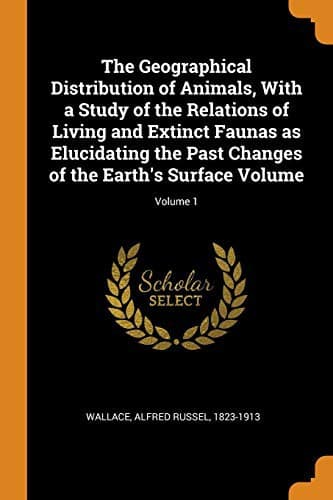
The Geographical Distribution of Animals, Volume 1: With a study of the relations of living and extinct faunas as elucidating the past changes of the Earth's surfaceWallace, Alfred Russel
Science
The Geographical Distribution of Animals, Volume 1: With a study of the relations of living and extinct faunas as elucidating the past changes of the Earth's surface
Wallace, Alfred Russel
Paleontology; Zoogeography
The marine shells are mostly Mediterranean, or West Indian species, with
some found in the Indian Ocean; only 4 or 5 species being peculiar to the
island.
_Tristan d'Acunha._--This small island is situated nearly midway between
the Cape of Good Hope and the mouth of the La Plata, but it is rather
nearer Africa than America, and a little nearer still to St. Helena. An
island so truly oceanic and of whose productions so little is known, cannot
be placed in any region, and is only noticed here because it comes
naturally after St. Helena. It is known to possess three peculiar land
birds. One is a thrush (_Nesocichla eremita_) whose exact affinities are
not determined; the other a small water-hen (_Gallinula nesiotis_) allied
to our native species, but with shorter and softer wings, which the bird
does not use for flight. A finch of the genus _Crithagra_ shows African
affinities; while another recently described as _Nesospiza acunhæ_ (Journ.
für Orn. 1873, p. 154) forms a new genus said to resemble more nearly some
American forms.
{272}The only known land-shells are 2 peculiar species of _Balea,_ a genus
only found elsewhere in Europe and Brazil.
_IV. Madagascar and the Mascarene Islands, or the Malagasy Sub-region._
This insular sub-region is one of the most remarkable zoological districts
on the globe, bearing a similar relation to Africa as the Antilles to
tropical America, or New Zealand to Australia, but possessing a much richer
fauna than either of these, and in some respects a more remarkable one even
than New Zealand. It comprises, besides Madagascar, the islands of
Mauritius, Bourbon, and Rodriguez, the Seychelles and Comoro islands.
Madagascar itself is an island of the first class, being a thousand miles
long and about 250 miles in average width. It lies parallel to the coast of
Africa, near the southern tropic, and is separated by 230 miles of sea from
the nearest part of the continent, although a bank of soundings projecting
from its western coast reduces this distance to about 160 miles. Madagascar
is a mountainous island, and the greater part of the interior consists of
open elevated plateaus; but between these and the coast there intervene
broad belts of luxuriant tropical forests. It is this forest-district which
has yielded most of those remarkable types of animal life which we shall
have to enumerate; and it is probable that many more remain to be
discovered. As all the main features of this sub-region are developed in
Madagascar, we shall first endeavour to give a complete outline of the
fauna of that country, and afterwards show how far the surrounding islands
partake of its peculiarities.
Public-domain text, read in full here on John Shaqi.
Reviews
Reviews
No reviews yet
Be the first to share your thoughts on this work.
Elsewhere in the archive
Join the Discussion
Join the discussion
Sign in to leave a comment or review.
Sign InorCreate an account