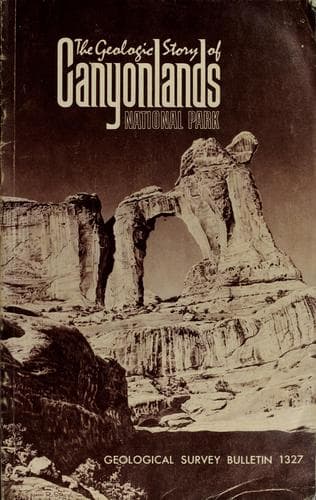
The Geologic Story of Canyonlands National Park — John Shaqi
The Geologic Story of Canyonlands National ParkLohman, Stanley William
Science
The Geologic Story of Canyonlands National Park
Lohman, Stanley William
Canyonlands National Park (Utah) -- Guidebooks; Geology -- Utah -- Canyonlands National Park -- Guidebooks
mainly crossbedded white to pale red sandstone with
thin beds of cherty limestone. Forms needles, arches
and other erosional features. Thickening southwestward
is the White Rim Sandstone Member of white crossbedded
sandstone.
800-1,000
Cutler Creek, Colo.
White Rim Sandstone Member
White Rim, Wayne Co., Utah
Organ Rock Tongue
Organ Rock, Utah
Cedar Mesa Sandstone Member
Cedar Mesa, S. E. Utah
Rico Formation
Buff, red, and purple arkosic sandstone and conglomerate
containing several thin beds of marine fossiliferous
limestone. Forms moderately steep slopes.
250-585
Rico, Colo.
300
Pennsylvanian
Hermosa Formation
Hermosa Creek, Animas River Valley, Colo.
Unnamed upper member
Blue, greenish, and gray fossiliferous limestone interbedded
with white, gray, and greenish sandstone and gray to
green shale. Lower part known only from deep wells.
Forms steep canyon walls.
900-1,800
Paradox Member
Salt, gypsum, and anhydrite with interbedded black and brown
shale; some limestone.
?
Paradox Valley, Colo.
Last but far from least among the factors responsible for the grandeur
of the canyon country is the desert climate, which allows us to see
virtually every foot of the vividly colored naked rocks and has made
possible the creation and preservation of such a wide variety of
fantastic sculptures. A wetter climate would have produced a far
different and smoother landscape in which most of the rocks and land
forms would have been hidden by vegetation. In the canyon lands the
vegetation is mainly on the high mesas and on the narrow flood plains
bordering the rivers, but scanty vegetation does grow on the gentle
slopes or flats.
The desert climate has combined with the nearly flat lying layers of
sediments of different character, hardness, and thickness to produce
steep slopes having many cliffs and ledges and generally sharp to
angular edges rather than the subdued rounded forms of more humid
regions. This has led geologists to refer to such terrain as having
“layer-cake geology,” and this is brought out by the profile in the rock
column (fig. 9), by the cross section (fig. 10), by figure 15, and by
many of the other photographs. But the baker of this cake was rather
careless—not only do the layers range widely in thickness and character,
but some are wedge shaped, thick on one side of the cake but thin or
absent on the other. Then too, when he ran out of icing in the midst of
a layer, he was apt to finish with a different kind or color, for no
inspector was on the job to insure orderly construction.
Public-domain text, read in full here on John Shaqi.
Reviews
Reviews
No reviews yet
Be the first to share your thoughts on this work.
Join the Discussion
Join the discussion
Sign in to leave a comment or review.
Sign InorCreate an account