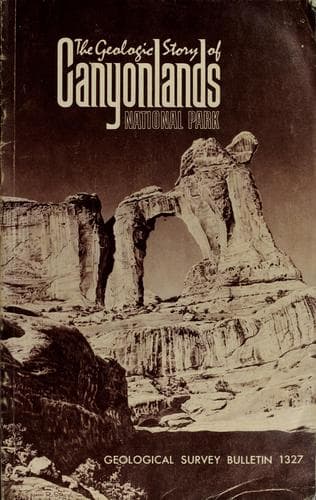
The Geologic Story of Canyonlands National ParkLohman, Stanley William
Science
The Geologic Story of Canyonlands National Park
Lohman, Stanley William
Canyonlands National Park (Utah) -- Guidebooks; Geology -- Utah -- Canyonlands National Park -- Guidebooks
If all the rock strata in the park were present at one locality, their
sequence and thickness would be those shown on the right-hand side of
the graphic section in figure 9. However, because of the lateral changes
in thickness and character and the wedging out of certain beds, such as
the White Rim Sandstone Member of the Cutler Formation, no two sections
of the strata are exactly alike. This will be brought out in photographs
of different exposures of rocks in various parts of the park.
An often-asked question is, why are most of the rocks so red? This can
be answered by one word—iron, the same pigment used in rouge and in
paint for barns and boxcars. Various oxides of iron, some including
water, produce not only brick red but also pink, salmon, brown, buff,
yellow, and even green or bluish green. This does not imply that the
rocks could be considered as sources of iron ore, for the merest trace
of iron, generally only 1 to 3 percent, is enough to produce even the
darkest shades of red. The only rocks in the park that contain virtually
no iron are white sandstones of the White Rim Sandstone Member of the
Cutler Formation (figs. 21-24) and the Navajo Sandstone.
[Illustration: Fig. 10, first section]
[Illustration: SECTION ACROSS CANYONLANDS NATIONAL PARK from North
Point at west (left), via Grand View Point in middle, to Needles
Overlook at east (right), showing the three principal topographic
levels and character of the rock strata. Line of section bends at
Grand View Point, which is northernmost part. (Fig. 10)]
As pointed out by Stokes (1970, p. 3), microscopic examination of the
colored grains of quartz or other minerals shows the pigment to be
merely a thin coating on and between white or colorless particles. Sand
or silt weathered from such rocks soon loses its color by the scouring
action of wind or water, so most of the sand dunes and sand bars are
white or nearly so.
Public-domain text, read in full here on John Shaqi.
Reviews
Reviews
No reviews yet
Be the first to share your thoughts on this work.
Join the Discussion
Join the discussion
Sign in to leave a comment or review.
Sign InorCreate an account