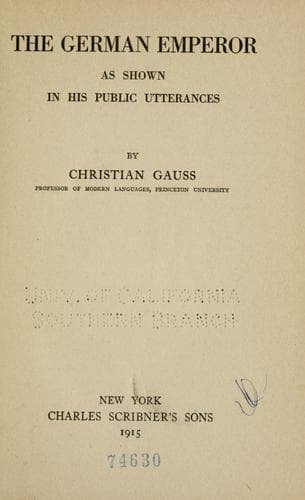
The German Emperor as Shown in His Public UtterancesWilliam II, German Emperor
History
The German Emperor as Shown in His Public Utterances
William II, German Emperor
Germany -- History -- William II, 1888-1918 -- Sources; Germany -- Politics And Government -- 1871-1918
But it fills me with pride and joy to-day when I think that Berlin
stands before the whole world with a body of artists who are capable
of carrying out such a magnificent work. It proves that the Berlin
school of sculpture stands at a height such as could hardly have been
surpassed even in the time of the Renaissance. And I think every one
of you will agree, without jealousy, that the effective example of
Rheinhold Begas and his conception, based upon his knowledge of the
antique, has been a guide to many of you in the working out of this
great task.
Here, also, we could draw a parallel between the great achievements in
the art of the Middle Ages and of the Italians; since in that time,
also, the sovereign and art-loving prince who offered the commissions
to the artists at the same time found the masters, about whom a crowd
of young disciples gathered, so that a certain school was in this way
developed which was able to accomplish remarkable things.
Now, gentlemen, the Pergamon Museum has also been opened on this same
day, in Berlin. I regard that, too, as a very important portion of
our art history and as a good omen and a happy coincidence. A more
magnificent collection cannot be imagined than the abundance of beauty
which is displayed in these rooms before the eyes of the astonished
observer.
But how does art stand in the world to-day? It takes its examples and
creates out of the great sources of Mother Nature; and Nature, in spite
of her great, apparently boundless, limitless freedom, acts according
to everlasting laws which the Creator has set for Himself and which
can never be infringed upon or overstepped without endangering the
development of the world.
It is the same in art. And in looking upon the magnificent remains
from the old classic period we experience the same feeling. Here, too,
an eternal, unchanging law rules; the law of beauty and harmony--of
æsthetics. This law was expressed by the ancients in so surprising and
powerful a manner and in so complete a form that we, for all our modern
perceptions and our power of accomplishment, are proud if it can be
said of some very especially good piece of work: "That is almost as
good as if it had been done 1900 years ago."
"Almost!" Under this impression I shall ask you to take this injunction
to heart. Sculpture has for the most part remained free from the
so-called modern tendencies and influences; it still stands high
and sublime. Keep it so; do not let yourselves be led astray by the
judgment of men and by all sorts of windy doctrines to give up these
great principles upon which it is based.
Public-domain text, read in full here on John Shaqi.
Reviews
Reviews
No reviews yet
Be the first to share your thoughts on this work.
Elsewhere in the archive
Join the Discussion
Join the discussion
Sign in to leave a comment or review.
Sign InorCreate an account