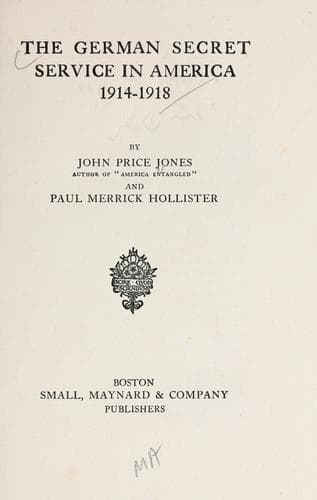
The German Secret Service in America 1914-1918Jones, John Price
History
The German Secret Service in America 1914-1918
Jones, John Price
World War, 1914-1918 -- Secret service -- Germany
Dr. Albert made plans for buying up carbolic acid to prevent it from
reaching the Allies. Dr. Hugo Schweitzer, a German-American chemist
of New York, paid down $100,000 cash on June 3, 1915, to the American
Oil & Supply Company in New Jersey as part payment of $1,400,000 for
1,212,000 pounds of carbolic acid, of which the American Oil & Supply
Company had directed the purchase from Thomas A. Edison. Dr. Schweitzer
said that he bought the liquid not to prevent it from falling into the
hands of the Allies but to use in the manufacture of medical supplies.
Not the least interesting of Dr. Albert's financial experiences is
that which conceived and bore the Bridgeport Projectile Company. In a
conference early in 1915 in the offices of G. Amsinck & Co., in New
York, Count von Bernstorff came to the conclusion that one way to
prevent the shipment of munitions to the enemy was to monopolize the
industry, or at least to control it financially as far as possible. Dr.
Albert made an unsuccessful attempt to buy the Union Metallic Cartridge
plant for $17,000,000. He chose as his lieutenants for his next task
Hugo Schmidt, the New York representative of the Deutsches Bank, and
Karl Heynen, whose past record had been auspicious, as agent for Mexico
of the Hamburg-American Line. Heynen it was who had smuggled a cargo
of arms ashore for Huerta at Vera Cruz, under the nose of the American
fleet; he had received some 40,000 pesos (Mexican) for the coup, and he
was regarded as a capable individual. On March 31, 1915, the Bridgeport
Projectile Company was incorporated for $2,000,000, paid in, with
Walter Knight as president, Heynen as treasurer, and Karl Foster as
secretary and counsel.
Schmidt drew up a contract with the new-born company calling for a
large order of shells. On May 17 Heynen reported to Albert that 534
hydraulic presses for making shells of calibres 2.95 to 4.8 had been
ordered, and would cost $417,550. These orders, with all others for
tools and machinery which the Bridgeport company placed, were so
well concealed about the business world that as late as August the
impression was current that Great Britain was financing the company.
On June 30 Heynen reported to Albert through Schmidt that the first
shell cases would be manufactured under United States government
inspection, in order to create the impression that the company was
anxious for American contracts, and so that immediate delivery could be
made in case such contracts were actually secured. "The most important
buildings, forges, and machine shops, are almost under roof; the other
buildings are fairly under way; presses, machinery and all other
materials are being promptly assembled, and there is every indication
that deliveries will commence as provided in the contract; i. e., on
Sept. 1st, 1915."
Public-domain text, read in full here on John Shaqi.
Reviews
Reviews
No reviews yet
Be the first to share your thoughts on this work.
Elsewhere in the archive
Join the Discussion
Join the discussion
Sign in to leave a comment or review.
Sign InorCreate an account