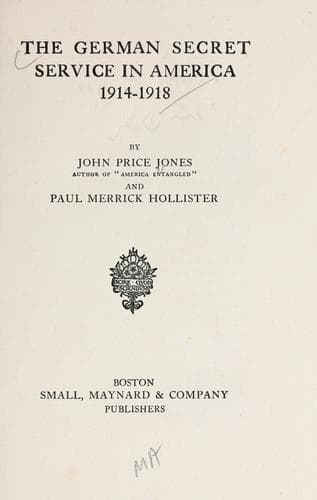
The German Secret Service in America 1914-1918Jones, John Price
History
The German Secret Service in America 1914-1918
Jones, John Price
World War, 1914-1918 -- Secret service -- Germany
The Bridgeport Projectile Company contracted with the Ætna Powder
Company, one of the largest producers of explosives in America, for
its entire output up to January, 1916, and then turned round and
offered the Spanish government a million pounds of powder. The Spanish
representatives may have suspected the identity of the company, for
they raised certain objections to the contract, to which Heynen
refused to listen, and he also reported to his superiors that British
and Russian purchasing agents were going to call on him within a few
days. He made a contract with Henry Disston & Co. for two million
pieces of steel, most of them tools, for which Schmidt advanced the
money. He contracted with the Camden Iron Works of Camden, N. J., for
presses, and posted a forfeit of $165,000 in case the contract should
be cancelled; the contract was signed and cancelled the next day by
the Bridgeport company, causing the Camden concern great business
difficulty.
Thus, by the manipulation of contracts, Dr. Albert and his associates
were accomplishing the following ends:
1. Arranging to supply Germany with shells and powder (as soon as
smuggling could be effected) at a time when official Germany was
attempting to persuade the United States to place an embargo on the
shipment of war materials to the Allies.
2. Securing a monopoly on all powder available.
3. So tying up the machinery and tool manufacturers that all their
production for months to come was under contract to the Bridgeport
Projectile Company, yet so wielding the cancellation clauses in its
contracts that delivery could be delayed and the date further postponed
when the manufacturers of machinery and tools could be free to take
Allied orders.
4. Arranging to accept contracts for the United States and the Allies
under such provisions that there would be no impossible forfeit if the
contracts could not be fulfilled. This would have the effect of making
the Allies believe that they were going to receive supplies which the
Bridgeport Projectile Company had no intention of furnishing them.
5. Heynen, by the contract with the munitions industry, which his
work afforded, knew where Allied orders for shells were placed, and
he learned to his pleasure that the Allies were being forced to
contract for shrapnel which was forged--a less satisfactory process
than pressing. He also learned that the first two orders for forged
shrapnel placed by the Allies had been rejected because the product was
inferior.
6. Paying abnormal wages with the unlimited funds at its disposal,
stealing labor from the Union Metallic Cartridge Company in Bridgeport,
and generally unsettling the labor situation.
7. Offering powder to Spain, a neutral with strong German affiliations.
Public-domain text, read in full here on John Shaqi.
Reviews
Reviews
No reviews yet
Be the first to share your thoughts on this work.
Elsewhere in the archive
Join the Discussion
Join the discussion
Sign in to leave a comment or review.
Sign InorCreate an account