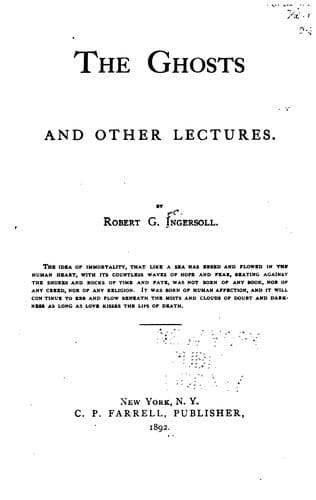
The Ghosts, and Other LecturesIngersoll, Robert Green
Religion
The Ghosts, and Other Lectures
Ingersoll, Robert Green
Free thought
Men found that the real was the useful; that what a man knows is better
than what a ghost says; that an event is more valuable than a prophecy.
They found that diseases were not produced by spirits, and could not be
cured by frightening them away. They found that death was as natural as
life. They began to study the anatomy and chemistry of the human body,
and found that all was natural and within the domain of law.
The conjurer and sorcerer were discarded, and the physician and surgeon
employed. They found that the earth was not flat; that the stars were
not mere specks. They found that being born under a particular planet
had nothing to do with the fortunes of men.
The astrologer was discharged and the astronomer took his place.
They found that the earth had swept through the constellations for
millions of ages. They found that good and evil were produced by natural
causes, and not by ghosts; that man could not be good enough or bad
enough to stop or cause a rain; that diseases were produced as naturally
as grass, and were not sent as punishments upon man for failing to
believe a certain creed. They found that man, through intelligence,
could take advantage of the forces of nature--that he could make the
waves, the winds, the flames, and the lightnings of heaven do his
bidding and minister to his wants. They found that the ghosts
knew nothing of benefit to man; that they were utterly ignorant
of geology--of astronomy--of geography;--that they knew nothing of
history;--that they were poor doctors and worse surgeons;--that they
knew nothing of law and less of justice; that they were without brains,
and utterly destitute of hearts; that they knew nothing of the rights
of men; that they were despisers of women, the haters of progress, the
enemies of science, and the destroyers of liberty.
The condition of the world during the Dark Ages shows exactly the result
of enslaving the bodies and souls of men. In those days there was no
freedom. Labor was despised, and a laborer was considered but little
above a beast. Ignorance, like a vast cowl, covered the brain of the
world, and superstition ran riot with the imagination of man. The air
was filled with angels, with demons and monsters. Credulity sat upon
the throne of the soul, and Reason was an exiled king. A man to be
distinguished must be a soldier or a monk. War and theology, that is
to say, murder and hypocrisy, were the principal employments of man.
Industry was a slave, theft was commerce; murder was war, hypocrisy was
religion.
Public-domain text, read in full here on John Shaqi.
Reviews
Reviews
No reviews yet
Be the first to share your thoughts on this work.
Join the Discussion
Join the discussion
Sign in to leave a comment or review.
Sign InorCreate an account