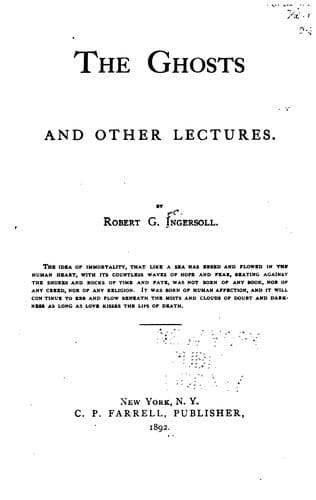
The Ghosts, and Other LecturesIngersoll, Robert Green
Religion
The Ghosts, and Other Lectures
Ingersoll, Robert Green
Free thought
Every christian country maintained that it was no robbery to take the
property of Mohammedans by force, and no murder to kill the owners. Lord
Bacon was the first man of note who maintained that a christian country
was bound to keep its plighted faith with an infidel nation. Reading and
writing were considered dangerous arts. Every layman who could read and
write was suspected of being a heretic. All thought was discouraged.
They forged chains of superstition for the minds, and manacles of iron
for the bodies of men. The earth was ruled by the cowl and sword,--by
the mitre and scepter,--by the altar and throne,--by Fear and Force,--by
Ignorance and Faith,--by ghouls and ghosts.
In the fifteenth century the following law was in force in England:
"That whosoever reads the scriptures in the mother tongue, shall forfeit
land, cattle, life, and goods from their heirs forever, and so be
condemned for heretics to God, enemies to the crown, and most arrant
traitors to the land."
During the first year this law was in force thirty-nine were hanged for
its violation and their bodies burned.
In the sixteenth century men were burned because they failed to kneel to
a procession of monks.
The slightest word uttered against the superstition of the time was
punished with death.
Even the reformers, so called, of those days, had no idea of
intellectual liberty--no idea even of toleration. Luther, Knox, Calvin,
believed in religious liberty only when they were in the minority. The
moment they were clothed with power they began to exterminate with fire
and sword.
Castellio was the first minister who advocated the liberty of the soul.
He was regarded by the reformers as a criminal, and treated as though he
had committed the crime of crimes.
Bodinus, a lawyer of France, about the same time, wrote a few words
in favor of the freedom of conscience, but public opinion was
overwhelmingly against him. The people were ready, anxious, and willing,
with whip, and chain, and fire, to drive from the mind of man the heresy
that he had a right to think.
Montaigne, a man blest with so much common sense that he was the most
uncommon man of his time, was the first to raise a voice against torture
in France. But what was the voice of one man against the terrible cry of
ignorant, infatuated, superstitious and malevolent millions? It was the
cry of a drowning man in the wild roar of the cruel sea.
In spite of the efforts of the brave few the infamous war against the
freedom of the soul was waged until at least one hundred millions of
human beings--fathers, mothers, brothers, sisters--with hopes, loves,
and aspirations like ourselves, were sacrificed upon the cruel altar
of an ignorant faith. They perished in every way by which death can
be produced. Every nerve of pain was sought out and touched by the
believers in ghosts.
Public-domain text, read in full here on John Shaqi.
Reviews
Reviews
No reviews yet
Be the first to share your thoughts on this work.
Join the Discussion
Join the discussion
Sign in to leave a comment or review.
Sign InorCreate an account