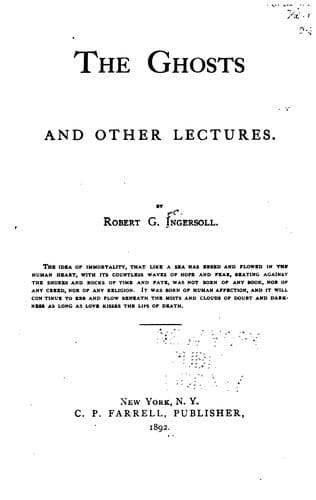
The Ghosts, and Other LecturesIngersoll, Robert Green
Religion
The Ghosts, and Other Lectures
Ingersoll, Robert Green
Free thought
In the olden time, they thought some days were too good for a child to
enjoy himself. When I was a boy Sunday was considered altogether too
holy to be happy in. Sunday used to commence then when the sun went down
on Saturday night. We commenced at that time for the purpose of getting
a good ready, and when the sun fell below the horizon on Saturday
evening, there was a darkness fell upon the house ten thousand times
deeper than that of night. Nobody said a pleasant word; nobody laughed;
nobody smiled; the child that looked the sickest was regarded as the
most pious. That night you could not even crack hickory nuts. If you
were caught chewing gum it was only another evidence of the total
depravity of the human heart. It was an exceedingly solemn night.
Dyspepsia was in the very air you breathed. Everybody looked sad and
mournful. I have noticed all my life that many people think they have
religion when they are troubled with dyspepsia. If there could be found
an absolute specific for that disease, it would be the hardest blow the
church has ever received.
On Sunday morning the solemnity had simply increased. Then we went to
church. The minister was in a pulpit about twenty feet high, with a
little sounding-board above him, and he commenced at "firstly" and went
on and on and on to about "twenty-thirdly." Then he made a few remarks
by way of application; and then took a general view of the subject, and
in about two hours reached the last chapter in Revelations.
In those days, no matter how cold the weather was, there was no fire in
the church. It was thought to be a kind of sin to be comfortable while
you were thanking God. The first church that ever had a stove in it in
New England, divided on that account. So the first church in which they
sang by note, was torn in fragments.
After the sermon we had an intermission. Then came the catechism with
the chief end of man. We went through with that. We sat in a row with
our feet coming in about six inches of the floor. The minister asked
us if we knew that we all deserved to go to hell, and we all answered
"Yes." Then we were asked if we would be willing to go hell if it was
God's will, and every little liar shouted "Yes." Then the same sermon
was preached once more, commencing at the other end and going back.
After that, we started for home, sad and solemn--overpowered with the
wisdom displayed in the scheme of the atonement. When we got home, if we
had been good boys, and the weather was warm, sometimes they would take
us out to the graveyard to cheer us up a little. It did cheer me. When
I looked at the sunken tombs and the leaning stones, and read
the half-effaced inscriptions through the moss of silence and
forget-fulness, it was a great comfort. The reflection came to my mind
that the observance of the Sabbath could not last always. Sometimes they
would sing that beautiful hymn in which occurs these cheerful lines:
"Where congregations ne'er break up,
And Sabbaths never end."
Public-domain text, read in full here on John Shaqi.
Reviews
Reviews
No reviews yet
Be the first to share your thoughts on this work.
Join the Discussion
Join the discussion
Sign in to leave a comment or review.
Sign InorCreate an account