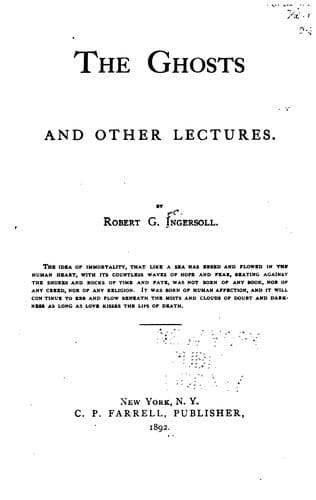
The Ghosts, and Other LecturesIngersoll, Robert Green
Religion
The Ghosts, and Other Lectures
Ingersoll, Robert Green
Free thought
These lines, I think, prejudiced me a little against even heaven. Then
we had good books that we read on Sundays by way of keeping us happy
and contented. There were Milners' "History of the Waldenses," Baxter's
"Call to the Unconverted," Yahn's "Archaeology of the Jews," and
Jenkyns' "On the Atonement." I used to read Jenkyns' "On the Atonement."
I have often thought that an atonement would have to be exceedingly
broad in its provisions to cover the case of a man who would write a
book like that for a boy.
But at last the Sunday wore away, and the moment the sun went down we
were free. Between three and four o'clock we would go out to see how the
sun was coming on. Sometimes it seemed to me that it was stopping from
pure meanness. But finally it went down. It had to. And when the last
rim of light sank below the horizon, off would go our caps, and we would
give three cheers for liberty once more.
Sabbaths used to be prisons. Every Sunday was a Bastile. Every christian
was a kind of turnkey, and every child was a prisoner,--a convict. In
that dungeon, a smile was a crime.
It was thought wrong for a child to laugh upon this holy day. Think of
that!
A little child would go out into the garden, and there would be a tree
laden with blossoms, and the little fellow would lean against it, and
there would be a bird on one of the boughs, singing and swinging, and
thinking, about four little speckled eggs, warmed by the breast of its
mate,--singing and swinging, and the music in happy waves rippling out
of its tiny throat, and the flowers blossoming, the air filled with
perfume and the great white clouds floating in the sky, and the little
boy would lean up against that tree and think about hell and the worm
that never dies.
I have heard them preach, when I sat in the pew and my feet did not
touch the floor, about the final home of the unconverted. In order to
impress upon the children the length of time they would probably stay if
they settled in that country, the preacher would frequently give us the
following illustration: "Suppose that once in a billion years a bird
should come from some far-distant planet, and carry off in its little
bill a grain of sand, a time would finally come when the last atom
composing this earth would be carried away; and when this last atom was
taken, it would not even be sun up in hell." Think of such an infamous
doctrine being taught to children!
Public-domain text, read in full here on John Shaqi.
Reviews
Reviews
No reviews yet
Be the first to share your thoughts on this work.
Join the Discussion
Join the discussion
Sign in to leave a comment or review.
Sign InorCreate an account