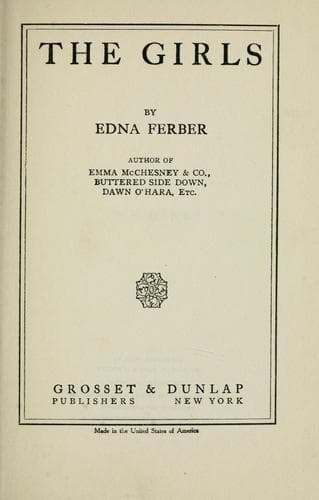
Chicago (Ill.) -- Fiction; Families -- Fiction; Women -- Fiction; World War, 1914-1918 -- Fiction
Had they been as wise and understanding as they were well-meaning,
these two calvinistic parents might have cured Charlotte by one visit
to the Dicks' Hardscrabble kitchen, with a mangy cur nosing her skirts;
a red-faced hostess at the washtub; and a ruined, battered travesty of
the slim young rhyme-making Jesse Dick there in the person of old Pete
Dick squatting, sodden, in the doorway.
As the years went on they had, tardily, a vague and sneaking hope that
something might happen among the G.A.R. widowers of Chicago's better
families. During the reunions of Company I and Company E Charlotte
generally assisted with the dinner or the musical program. She had
a sweet, if small, contralto with notes in it that matched the fine
dark eyebrows. She sang a group of old-fashioned songs: When You and
I Were Young, Maggie; The Belle of Mohawk Vale; and Sleeping I Dream,
Love. Charlotte never suspected her parents' careful scheming behind
these public appearances of hers. Her deft capable hands at the G.A.R.
dinners, her voice lifted in song, were her offerings to Jesse Dick's
memory. Him she served. To him she sang. And gradually even Isaac
and Hetty Thrift realized that the G.A.R. widowers were looking for
younger game; and that Charlotte, surrounded by blue-uniformed figures,
still was gazing through them, past them, into space. Her last public
appearance was when she played the organ and acted as director for
_Queen Esther_, a cantata, which marked rather an epoch in the
amateur musical history of the town. After that she began to devote
herself to her sister's family and to her mother.
But all this was later. Charlotte, at thirty, still had a look of
vigor, and of fragrant (if slightly faded) bloom, together with a
little atmosphere of mystery of which she was entirely unconscious;
born, doubtless, of years of living with a ghost. Attractive qualities,
all three; and all three quite lacking in her tart-tongued and
acidulous younger sister, despite that miss's ten-year advantage.
Carrie was plain, spare, and sallow. Her mind marched with her
father's. The two would discuss real estate and holdings like two men.
Hers was the mathematical and legal-thinking type of brain rarely
found in a woman. She rather despised her mother. Samuel Payson used
to listen to her with an air of respectful admiration and attention.
But it was her older sister to whom he turned at last with, "I thought
perhaps you might enjoy a drive to Cleaversville, since the evening's
so fine, Miss Charlotte. What do you say, Miss Charlotte?"
"Oh, thank you--I'm not properly dressed for driving--perhaps
Carrie----"
"Nonsense!" Mrs. Thrift would interpose tartly.
"But Miss Charlotte, you are quite perfectly dressed. If I may be so
bold, that is a style which suits you to a marvel."
Public-domain text, read in full here on John Shaqi.
Reviews
Reviews
No reviews yet
Be the first to share your thoughts on this work.
Join the Discussion
Join the discussion
Sign in to leave a comment or review.
Sign InorCreate an account