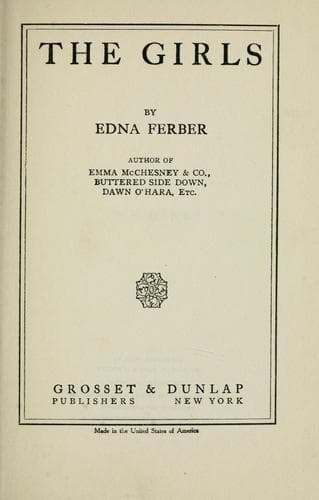
Chicago (Ill.) -- Fiction; Families -- Fiction; Women -- Fiction; World War, 1914-1918 -- Fiction
There he was right. It did. Hoops were history. The form-fitting
basque, the flattering neck-frill, the hip sash, and the smart
(though grotesque) bustle revealed, and even emphasized, lines of the
feminine figure--the swell of the bust, the curve of the throat--that
the crinoline had for years concealed. This romantic, if somewhat
lumpy, costume well became Charlotte's slender figure and stern sad
young face. In it Carrie, on the other hand, resembled a shingle in a
flower's sheath.
This obstacle having been battered down, Charlotte raised another.
"They say the Cleaversville road is a sea of mud and no bottom to it
in places. The rains."
"Then," said Samuel Payson, agreeably, "we shall leave that for another
time"--Charlotte brightened--"and go boating in the lagoon instead. Eh,
Miss Charlotte?"
Charlotte, born fifty years later, would have looked her persistent and
unwelcome suitor in the eye and said, "I don't want to go." Charlotte,
with the parental eyes upon her, went dutifully upstairs for bonnet and
mantle.
The lagoon of Samuel Payson's naming was a basin of water between the
narrow strip of park on Michigan Avenue and the railway that ran along
the lake. It was much used for boating of a polite and restricted
nature.
It was a warm Sunday evening in the early summer. The better to get
the breeze the family was sociably seated out on what was known as the
platform. On fine evenings all Chicago sat out on its front steps--"the
stoop" it was called. The platform was even more informal than the
stoop. It was made of wooden planks built across the ditches that ran
along each side of the street. Across it carriages drove up to the
sidewalk when visitors contemplated alighting. All down Wabash Avenue
you saw families comfortably seated in rockers on these platforms,
enjoying the evening breeze and watching the world go by. Here the
Thrifts--Isaac, Hetty, and their daughter Carrie--were seated when the
triumphant Samuel left with the smoldering Charlotte. Here they were
seated when the two returned.
The basin reached, they had hired a boat and Samuel had paddled about
in a splashy and desultory way, not being in the least an oarsman. He
talked, Miss-Charlotteing her so insistently that in ten minutes she
felt thumbed all over. She looked out across the lake. He spoke of his
loneliness, living at the Tremont House. Before being raised to junior
partner he had been a clerk in Isaac Thrift's office. It was thus that
Charlotte still regarded him--when she regarded him at all. She looked
at him now, bent to the oars, his flat chest concave, his lean arms
stringy; panting a little with the unaccustomed exercise.
"It must be lonely," murmured Charlotte, absentmindedly if
sympathetically.
"Your father and mother have been very kind"--he bent a melting look on
her--"far kinder than you have been, Miss Charlotte."
"It's chilly, now that the sun's gone," said Charlotte. "Shall we row
in? This mantle is very light."
Public-domain text, read in full here on John Shaqi.
Reviews
Reviews
No reviews yet
Be the first to share your thoughts on this work.
Join the Discussion
Join the discussion
Sign in to leave a comment or review.
Sign InorCreate an account