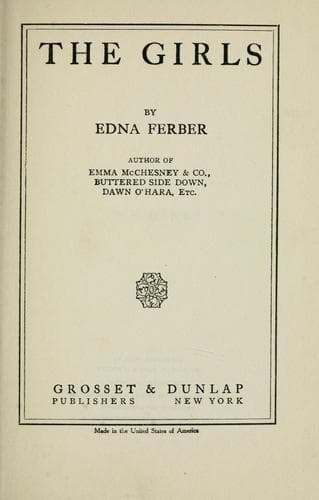
Chicago (Ill.) -- Fiction; Families -- Fiction; Women -- Fiction; World War, 1914-1918 -- Fiction
"I was a little wrong there," he admitted, "but only because I was
too conservative. They laughed at me. Well, you can't deny the truth
of it now. It'll be as good a hundred years from now as it is to-day.
Only the finest houses because of the cost of the ground. No chance of
business ever coming up this way. From Sixteenth to Thirtieth it's a
residential paradise. Yes sir! A res-i-den-tial paradise!"
A good thing that he did not live the twenty-five years, or less,
that transformed the paradise into a smoke-blackened and disreputable
inferno, with dusky faces, surmounted by chemically unkinked though
woolly heads, peering from every decayed mansion and tumble-down
rooming house. Sixteenth Street became a sore that would not
heal--scrofulous, filthy. Thirty-first Street was the centre of the
Black Belt. Of all that region Prairie Avenue alone resisted wave
after wave of the black flood that engulfed the streets south, east,
and west. There, in Isaac Thrift's day, lived much of Chicago's
aristocracy; millionaire if mercantile; plutocratic though porcine. And
there its great stone and brick mansions with their mushroom-topped
conservatories, their porte-cochères, their high wrought-iron fences,
and their careful lawns still defied the years, though ruin, dirt, and
decay waited just outside to destroy them. The window-hangings of any
street are its character index. The lace and silk draperies before
the windows of these old mansions still were immaculate, though the
Illinois Central trains, as they screeched derisively by, spat huge
mouthsful of smoke and cinders into their very faces.
Isaac Thrift had fallen far behind his neighbours in the race for
wealth. They had started as he had, with only courage, ambition, and
foresight as capital. But they--merchants, pork-packers--had dealt
in food and clothing on an increasingly greater scale, while Isaac
Thrift had early given up his store to devote all his time to real
estate. There had been his mistake. Bread and pork, hardware and
clothing--these were fundamental needs, changing little with the years.
Millions came to the man who, starting as a purveyor of these, stayed
with them. At best, real estate was a gamble. And Isaac Thrift lost.
His own occasional short-sightedness was not to blame for his most
devastating loss, however. This was dealt him, cruelly and criminally,
by his business partner and son-in-law, the plausible Payson.
Public-domain text, read in full here on John Shaqi.
Reviews
Reviews
No reviews yet
Be the first to share your thoughts on this work.
Join the Discussion
Join the discussion
Sign in to leave a comment or review.
Sign InorCreate an account