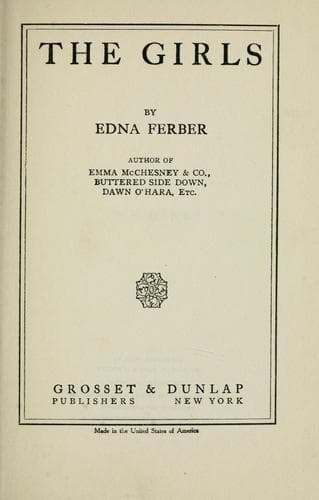
Chicago (Ill.) -- Fiction; Families -- Fiction; Women -- Fiction; World War, 1914-1918 -- Fiction
The two families dwelt comfortably enough together in the new house on
Prairie. There was room and to spare, even after two children--Belle,
and then Lottie--were born to the Paysons. The house was thought a
grand affair, with its tin bathtub and boxed-in wash-bowl on the second
floor, besides an extra washroom on the first, off the hall; a red
and yellow stained-glass window in the dining room; a butler's pantry
(understand, no butler; Chicago boasted no more than half a dozen of
these); a fine furnace in the lower hall just under the stairway;
oilcloth on the first flight of stairs; Brussels on the second; ingrain
on the third; a liver-colored marble mantel in the front parlor, with
anemic replicas in the back parlor and the more important bedrooms.
It was an age when every possible article of household furniture
was disguised to represent something it was not. A miniature Gothic
cathedral was really a work-basket; a fauteuil was, like as not, a
music box. The Thrifts' parlor carpet was green, woven to represent a
river flowing along from the back parlor folding doors to the street
windows, with a pattern of full-sailed ships on it, and, by way of
variety, occasional bunches of flowers strewn carelessly here and
there, between the ships. On rare and thrilling occasions, during their
infancy, Belle and little Lottie were allowed to crawl down the carpet
river and poke a fascinated finger into a ship's sail or a floral
garland.
Carrie's two children were born in this house. Isaac and Hetty Thrift
died in it. And in it Carrie was left worse than widowed.
Samuel Payson must have been about forty-six when, having gathered
together in the office of Thrift & Payson all the uninvested
moneys--together with negotiable bonds, stocks, and securities--on
which he could lay hands, he decamped and was never seen again. He
must have been planning it for years. It was all quite simple. He had
had active charge of the business. Again and again Isaac Thrift had
turned over to Payson money entrusted him for investment by widows of
lifelong friends; by the sons and daughters of old Chicago settlers; by
lifelong friends themselves. This money Payson had taken, ostensibly
for investment. He had carefully discussed its investment with his
father-in-law, had reported such investments made. In reality he had
invested not a penny. On it had been paid one supposed dividend,
or possibly two. The bulk of it remained untouched. When his time
came Samuel Payson gathered together the practically virgin sums and
vanished to live some strange life of his own of which he had been
dreaming behind that truckling manner and the Heepish face, with its
red-rimmed eyes.
He had been a model husband, father, and son-in-law. Chess with old
Isaac, evenings; wool-windings for Mrs. Thrift; games with the two
little girls; church on Sundays with Carrie. Between him and Charlotte
little talk was wasted, and no pretense.
Public-domain text, read in full here on John Shaqi.
Reviews
Reviews
No reviews yet
Be the first to share your thoughts on this work.
Join the Discussion
Join the discussion
Sign in to leave a comment or review.
Sign InorCreate an account